
Extract every quantity in a codebase — the number and its unit
normalised to one base unit so two configs can be compared, and refused by name when it cannot be




Useful? A star is how other developers find it — ★ GitHub · letools.dev/tools/units-le
timeout: 30s in one service and timeout: 30000 in another are the
same number of milliseconds, and nothing about the text says so.
memory: 1GB and memory: 1GiB differ by 7% and look identical at a
glance. Someone has to reconcile them — before a migration, against a
runbook, against a retention policy that states the limit in words.
A schema validator does not serve them: it checks that a field is a
string. A duration-parsing library does not either — it resolves
1.5KB to 1500 and a bare m to whichever unit its author picked,
silently, which is the failure this tool exists to prevent.
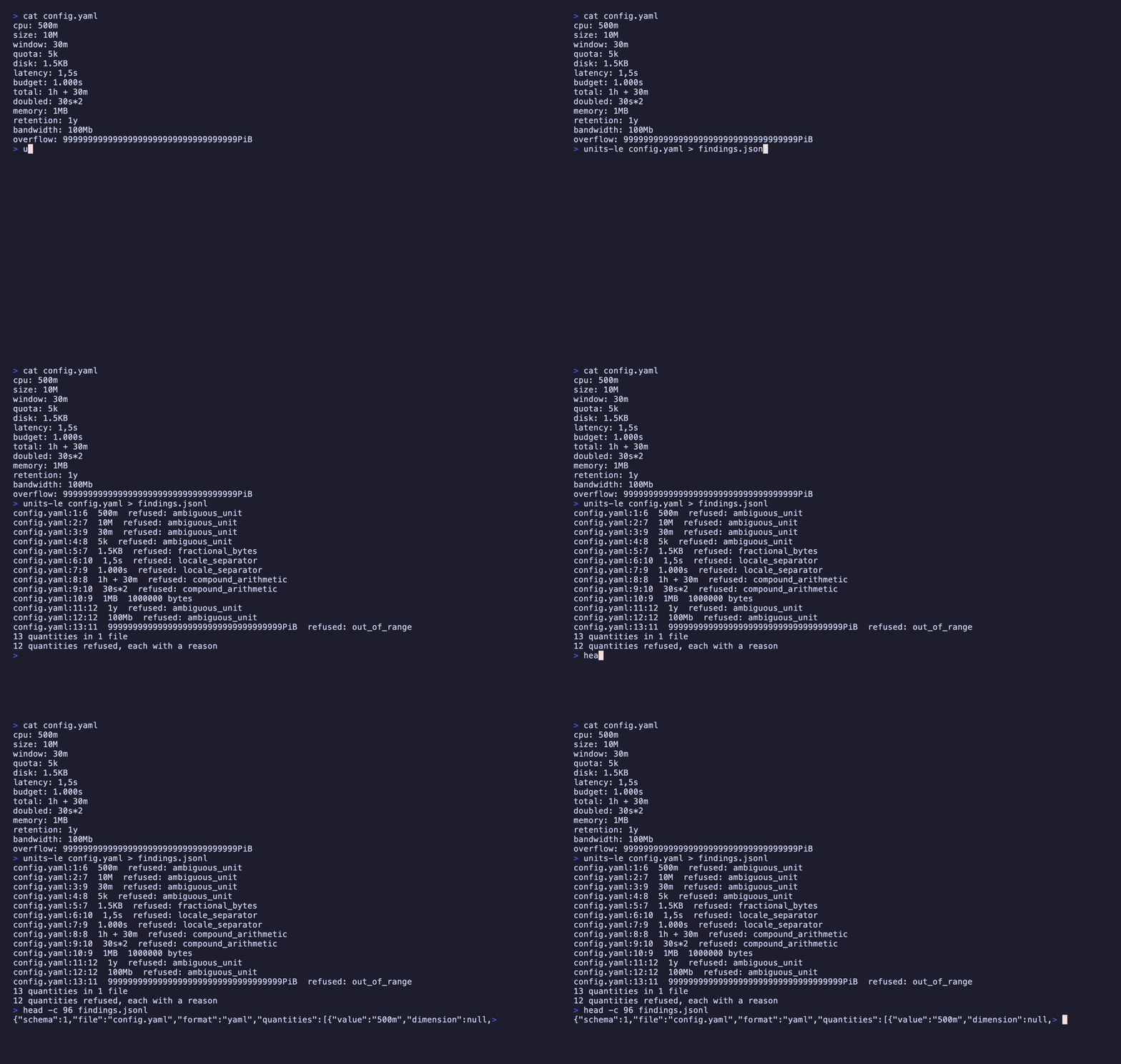
units-le walks a tree, finds every quantity in it — a number welded to a unit — and reports each one twice: as the document wrote it, and in one base unit so two of them can be compared.
units-le config/config/api.yaml:1:10 1h30m 5400000 milliseconds
config/api.yaml:2:9 1MB 1000000 bytes
config/cache.yaml:1:6 512MiB 536870912 bytes
config/cache.yaml:2:6 500m refused: ambiguous_unit
4 quantities in 2 files
1 quantity refused, each with a reason
That is stderr, for a person. stdout is protocol — one JSON report per line, one line per file:
{
  "schema": 1,
  "file": "config/cache.yaml",
  "format": "yaml",
  "quantities": [
    {
      "value": "512MiB",
      "dimension": "bytes",
      "baseUnit": "bytes",
      "base": "536870912",
      "key": "ttl",
      "line": 1,
      "column": 6
    },
    {
      "value": "500m",
      "dimension": null,
      "baseUnit": null,
      "base": null,
      "reason": "ambiguous_unit",
      "detail": "`m` is minutes in one config format, milliseconds in another and millicores in Kubernetes. Write `min`, `ms`, or spell out the core count.",
      "key": "cpu",
      "line": 2,
      "column": 6
    }
  ],
  "diagnostics": [],
  "summary": { "quantities": 2, "refused": 1 }
}
There is no --json flag. One mode, nothing to misremember, and the
human summary is a projection of the same reports so the two cannot
drift.
cargo install units-leOr build it from this repository:
git clone https://github.com/nolindnaidoo/units-le
cd units-le/crate
cargo build --release      # target/release/units-le
Needs Rust 1.88+, which is the version CI checks the declared MSRV against. No runtime, no network, nothing written.
This is the whole product. Any tool can multiply 30s by a thousand;
what makes this one usable in a review is that it will not pretend.
| It sees | Reason | What comes back |
|---|---|---|
500m, 10M, 5k, 1y, 100Mb |
ambiguous_unit |
no base value — m is minutes, milliseconds or Kubernetes millicores; M is mega- or minutes; k/K/G/T/P are prefixes with no unit after them; a calendar year has no fixed length; a lowercase b is bits by the standard and bytes in most software that writes it |
1.5KB, 1.5KiB |
fractional_bytes |
no base value — a byte count has no fractional part. 1.5KiB is exactly 1536 bytes and is still refused: the refusal is about the category, not the arithmetic |
1,5s, 1.000s, 1.2.3s |
locale_separator |
no base value — one and a half, or fifteen hundred? This tool does not infer a locale. Narrowed so 0.825s and 2.5s read normally |
1h + 30m, 30s*2 |
compound_arithmetic |
no base value — an expression, not a quantity, reported as one finding rather than two |
1MB, 256KB |
si_iec_hazard |
the base value, plus the reason — see below |
99999…PiB |
out_of_range |
no base value — it does not fit in 128 bits, and is refused rather than wrapped |
Every one of them keeps its row, its source text, its position and a sentence a person can act on. A refusal is never a dropped row and never a guess.
It is the one reason that still answers. MB is 10^6 by the standard,
so 1MB comes back as 1000000 bytes and carries
reason: "si_iec_hazard" — because a great deal of software writes
MB and means 2^20. Reporting nothing would be less useful than
reporting the standard answer with the flag attached, and picking 2^20
would be the guess this tool exists not to make.
So it is not counted in summary.refused and it does not trip
--strict. A row with si_iec_hazard is the only row that carries both
a base and a reason; every other reason means the base is null.
A bare number with no unit is not a finding at all. timeout: 30
yields nothing here — that is
numbers-le's question, and
the boundary is what keeps the two tools distinct.
| Dimension | Base unit | Units read |
|---|---|---|
duration |
milliseconds | ns us µs μs ms s sec secs min mins h hr hrs d day days w · compounds 1h30m · ISO-8601 PT1H30M P1DT2H P2W PT0.5S |
bytes |
bytes | B · SI kB KB MB GB TB PB · IEC KiB MiB GiB TiB PiB · Kubernetes Ki Mi Gi Ti Pi |
percent |
ratio | % — 15% is 0.15 |
frequency |
hertz | Hz kHz KHz MHz GHz THz |
Case is part of the symbol. MB is a megabyte and Mb is a
megabit; folding them would silently multiply by eight, so Mb is
refused rather than treated as a synonym.
1h30m is a grammar and 1h + 30m is arithmetic. The first is one
quantity written in two parts. Inside a compound the parts disambiguate
each other — m alone is refused, and m between h and s can only
be minutes, because a compound is written largest-first. That ordering
is required rather than assumed, so 30s1h is not a quantity at all.
Physical units are a non-goal, not a gap. Length, mass, temperature
belong to a different question, and reading them would mean unit algebra
(m/s²), which is what uom is for. See
crate/SPEC.md.
Following grep, as the rest of the family does:
- 0 — quantities found.
- 1 — none found. An answer, not an error.
- 2 — the question was malformed: an unknown flag, an unrecognised dimension, a path that does not exist.
A refusal does not change the exit code. A tree full of ambiguous
units is a real result, and if units-le config/; then has to see it as
success. --strict is the opt-in for a pipeline that wants every
quantity resolved or the build stopped: it exits 2 on any refusal, and
on any text file that could not be read.
Exit 2 does not mean one file in fifty thousand was a PNG. A binary file — a NUL byte in the first 8 KiB, ripgrep's own test — produces no report line and never affects the exit code; it is counted on stderr so a reader still knows coverage was narrower than the tree.
--dimension <name>   report only duration, bytes, percent or frequency
--format <format>    force a format instead of inferring from the name;
                     an unknown name falls back to the text scan
--strict             exit 2 if any quantity was refused, or any text
                     file could not be read
--stdin              read one document from stdin
--hidden             walk hidden files and directories too
--no-ignore          walk files that .gitignore excludes
units-le .                                 # every quantity in the tree
units-le --dimension duration config/      # only the timeouts
units-le --strict config/                  # exit 2 if anything was refused
cat values.yaml | units-le --stdin --format yaml

# the point of the whole thing:
units-le config/ | jq -r '.quantities[] | select(.dimension=="duration") | "\(.key)\t\(.base)"'
A format falls back and a dimension does not. A format nobody recognises still has an answer — scan the text. A dimension nobody recognises has none, and quietly reporting all four would answer a question that was not asked.
A refusal that names no dimension survives every filter. A bare
500m could be a duration or a byte count — that is why it was refused
— so dropping it under --dimension bytes would be the tool deciding
what it just said it could not decide.
JSON, YAML, CSV, TOML, INI and dotenv are parsed. Everything else is scanned as text — a Kubernetes manifest, a Terraform file, a Markdown table of limits, a log — so the files where quantities actually live yield them rather than nothing.
Unlike numbers-le's text scan, this one has a shape to look for, so
v1.2.3 yields nothing rather than two numbers. Every format with a
shape carries a key path — cache.ttl, limits[0], server.timeout,
TIMEOUT — and every finding carries a 1-based line and column, the
column in UTF-16 units, which is the number your editor shows.
Its false-positive class is measured rather than imagined. A run
inside an opaque blob still reads as a quantity: 001d in a UUID is one
day, and a base64 hash ending /2w== is two weeks. The boundary
characters that let those through are the same ones that let -30s and
ttl=30s through. Over crate/fixtures/documents/opaque.txt — 280
lines of lockfile hashes, container digests, git object names, UUIDs and
signing material, none of which is a quantity — the scan reports 5
false findings, 1.8%, and a test prints that number on every run.
Each one carries its line and column, which is what makes it a row you
discard rather than a number you trust.
units-le mcpTwo tools, both returning { ok, data, diagnostics, meta }:
extract_units— content in, quantities out, with key paths and positions. Touches no filesystem.units_le_scan— files or directories in, the same reports the CLI writes.
ok reports whether the check ran, never whether the answer was yes. A
refusal is a successful answer carrying a reason; only a malformed
question is an error.
No "this timeout is too low". No defaults database. No conversion flag, no rewriting, no arithmetic. It reports what a document says and what that means in one base unit; which limits are right is the reviewer's call.
| What | Where |
|---|---|
| What the tool is allowed to say — scope, output contract, refusals, non-goals | crate/SPEC.md |
| How the code is written and held together — architecture, invariants, the gates | crate/AGENTS.md |
| The crate's own front page | crate/README.md |
| What changed | CHANGELOG.md · crate/CHANGELOG.md |
| The tool's page, and the other fifteen | letools.dev/tools/units-le |
Sixteen single-purpose tools for the work in front of every model. Each ships a Rust CLI and an MCP server. One page: letools.dev
Get it out
- String-LE — Extract every string in a codebase, with its position, so a person can read them
- Numbers-LE — Extract every hardcoded number in a codebase, so a person can check them
- Units-LE — Extract every quantity with its unit, normalized, and refuse the ambiguous ones by name
- Dates-LE — Extract every date and timestamp, and the exact instant each one resolves to
- IDs-LE — Extract every UUID, ULID, NanoID, ObjectId and Snowflake, and decode the time inside
- IPs-LE — Extract every IP address, CIDR block and MAC, normalized and classified by scope
- URLs-LE — Extract every URL in a codebase, with its protocol and exact position
- Paths-LE — Extract every file path in a codebase, and say whether it still points at anything
- Colors-LE — Extract every color in a codebase, and say which ones are not in your palette
Check it
- Regex-LE — Find every regex in a codebase, and report which can be driven into catastrophic backtracking
- Versions-LE — Find where one dependency is constrained differently across a repository's manifests
- i18n-LE — Identify the i18n library a project uses, then audit its catalogs by that library's rules
- Scrape-LE — Check whether a page is scrapeable before the scraper is written, and say when it cannot tell
Guard it
- Secrets-LE — Find hardcoded credentials in a codebase, and never print one into the report
- EnvSync-LE — Compare the dotenv files in a tree, and say which keys are missing from which
- Unicode-LE — Find the Unicode that hides meaning — bidi controls, invisibles, homoglyphs, mixed scripts
Each stands on its own: no shared crate, no published core. Where two of them agree, it is because the same answer was right twice.
Contact — nolindnaidoo.com · GitHub · LinkedIn
Rust — pixelcoords and pixelactions are one loop: pixelcoords answers where, pixelactions acts there. Their own tools, their own voice — not part of the LE family.
- pixelcoords — Freeze your screen, mark regions, get pixel-exact coordinates and crops pixelcoords.dev · crates.io · docs.rs
- pixelactions — Consume human-verified coordinates, perform the interaction, confirm it landed pixelactions.dev · crates.io · docs.rs
MIT © nolindnaidoo — see LICENSE.