
Merchant-side agentic commerce infrastructure for India's long-tail sellers. Turns a merchant's messy real-world catalog — Instagram photos, Hinglish captions, broken price formats — into something an AI buyer agent can actually buy from, with every money action explainable, bounded and gated.
Demo video: Watch the walkthrough · Live:
https://agentstore.antideploy.com · Audit viewer:
/viewer · Discovery doc:
/.well-known/agent-store.json
Test mode, permanently. This project never touches live payment credentials. The server refuses to start on anything but a
rzp_test_…key.
India's payment rails are becoming agent-ready — UPI Reserve Pay lets a human pre-authorise an agent to spend, and NPCI has signalled an agentic payments layer. But an AI shopping agent cannot buy from a long-tail merchant, because that merchant has no machine-readable catalog, no stock or price API, and no protocol endpoint. Their catalog is a stack of Instagram photos with Hinglish captions. agent-store is the missing merchant side: it turns that messy catalog into something an AI agent can actually buy from — safely.
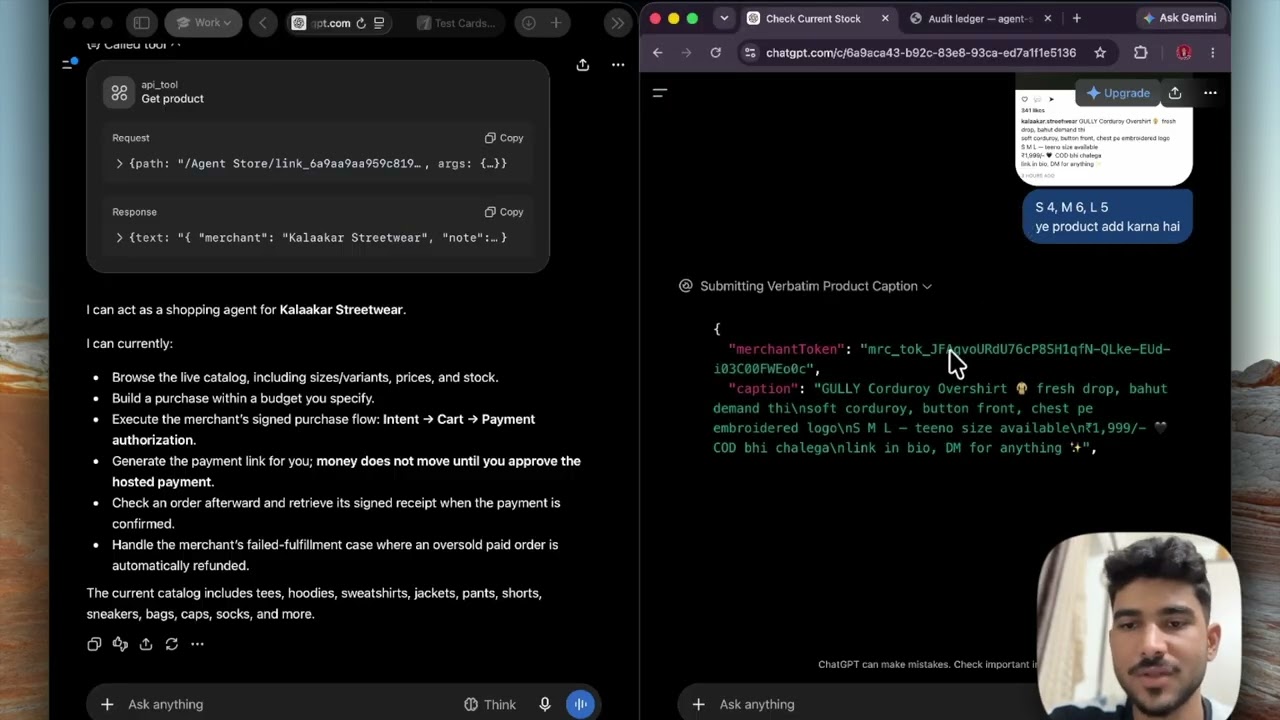
1. A merchant adds a product by pasting their own caption. No forms, no spreadsheet. They talk to Claude, drop in an Instagram screenshot, and the server reads the caption and builds the product. Crucially, the AI never guesses: it reports a confidence for every field, and anything it is not sure about — almost always the stock count, which captions rarely state — puts the whole product on hold until a human answers. That gate is the point, not an inconvenience.
2. An AI buyer agent can then find and buy that product. Over MCP (the protocol Claude speaks) or a plain REST twin. The purchase is not one "checkout" call — it is a signed chain: the agent declares what it wants and a budget, gets back an immutable cart with the price locked by hash, and only then can pay. Every step is signed by both sides.
3. Every rupee is explainable after the fact. Each decision is written to an append-only audit log, and a separate auditor recomputes the whole ledger from scratch to check the server did not cheat. You can replay any purchase, event by event, in a browser.
Money is integer paise, never floats. Payments settle on real Razorpay test-mode rails — the server refuses to boot on a live key.
The full demo — happy purchase, a fail-closed decline, and an oversell caught and refunded.
The confidence gate — an AI-read caption waiting for the one thing it refused to invent.
The left column is what extraction read, with the model's own confidence per field; stock
is held at 0.00 because the caption never stated it. Nothing publishes until a human answers.

A purchase replayed from the audit log. The signed chain, event by event — the Agent's signed Intent with its Budget, the immutable Cart with its price locked by hash, the verified Payment mandate, and the Order created only after the trust gate passed. Green "WHY ALLOWED" boxes explain each gate in English. The replay then continues through the Razorpay call recorded before it was made, the signed webhook, the merchant-signed Receipt, and the atomic stock decrement — see the full replay live.

The ledger. Every Order and every Refusal the trust layer wrote, in the audit log's own sequence — never by timestamp.

flowchart TB
    subgraph merchant["MERCHANT SIDE"]
        M["Merchant in claude.ai chat<br/>drops an IG screenshot"]
        MF["POST /merchant/mcp<br/>8 tools, merchantToken"]
        M -->|"caption, verbatim"| MF
    end

    subgraph core["THE SERVER — all judgement lives here"]
        EX["Extraction<br/>provider-agnostic, zod-validated<br/>per-field confidence"]
        GATE{"confidence >= 0.90<br/>for every field?"}
        HELD["needs_confirmation<br/>whole Product waits"]
        CAT[("Catalog<br/>Products / Variants<br/>integer paise")]
        TRUST["Trust layer<br/>Cap · Budget · price hash<br/>stock · idempotency"]
        AUDIT[("Append-only audit log<br/>hash-chained")]
    end

    subgraph buyer["BUYER SIDE"]
        BF["POST /mcp · 6 tools<br/>+ /acp/* REST twin"]
        B["AI buyer agent<br/>(claude.ai connector)"]
        B <--> BF
    end

    MF --> EX --> GATE
    GATE -->|"no"| HELD
    HELD -->|"merchant answers<br/>in chat or on the web desk"| CAT
    GATE -->|"yes"| CAT
    BF --> TRUST
    TRUST --> CAT
    TRUST -->|"Intent -> Cart -> Payment<br/>each signed"| RZP["Razorpay<br/>test-mode rails"]
    RZP -->|"signed webhook"| TRUST
    TRUST --> AUDIT
    EX --> AUDIT
    AUDIT --> V["/viewer<br/>replay any Order or Refusal"]
    AUDIT --> RA["npm run audit:rules<br/>independent re-check"]
The one rule that shapes everything: the server decides, the client never does. Extraction runs server-side even when the request arrives from a chat client, so a connector can never hand over a pre-extracted price at confidence 1.0. Every trust check runs before any gateway call, so a refusal always means zero money moved.
| Add a product from a chat message | Paste the caption you already wrote. submit_catalog_item on /merchant/mcp runs the same pipeline the batch importer uses. Optionally attach a public photo URL or inline base64. |
| Extraction runs server-side, always | A chat client sends the caption verbatim and nothing else. It cannot hand over a pre-extracted price at confidence 1.0, which is the failure mode that would make the whole confidence model meaningless. |
| Per-field confidence with a hard gate | Every field carries the model's own score. Anything below 0.90 holds the entire Product in needs_confirmation — not just that field — so a Variant can never be bought at a price nobody verified. |
| Stock is never invented | Captions almost never state stock. The pipeline returns null at confidence 0.00 rather than guessing, and refuses to publish without a stated count. 0 means sold out; absent means unknown. |
| Confirm in chat or on the web | confirm_product answers the held fields in the next chat turn; /viewer/confirm is the batch screen. The chat path is additive — a Variant you do not mention keeps its stored values and is never deleted. |
| Run the store from chat | store_summary (published/held counts, Orders by status, revenue in paise, low stock, sold out, Refusals as unmet demand), list_recent_orders, get_order. |
| Deterministic price parsing | ₹499/- only, sirf 699, Rs.999, 1,599 flat, MRP strikethroughs and %-off lines are parsed by code, not by the model. Numbers that are not prices (free-shipping thresholds, COD limits) are rejected. |
| Two protocol faces, one core | MCP (/mcp, Streamable HTTP, stateless) and an ACP-flavoured REST twin (/acp/*) with identical semantics, Refusals and Receipts. A /.well-known discovery doc describes both. |
| Signed mandate chain | Not a single checkout call. declare_intent (want + Budget) → create_cart (immutable, both sides signed, price pinned by hash) → submit_payment. A cart made stale by a price change refuses PRICE_CHANGED. |
| Bounded spending | A Cap declared per agent at registration and a Budget per purchase. Exceeding either is a structured Refusal, before any gateway call. |
| Custody that matches the client | A connector-based agent cannot hold a private key, so the server signs custodially; an Agent-SDK buyer signs locally. Both produce the same verifiable chain. |
| Idempotent money actions | The buyer mints the idempotency key; replaying a submit_payment cannot double-charge. |
| Real rails | Razorpay test mode, signature-verified webhooks, payment link as the human consent step. |
| Every check runs before the gateway | A Refusal therefore always means zero money moved — that is a structural property, not a promise. |
| Written before it happens | The outbound call is recorded as *_attempted before it is made, so a crash mid-request leaves a trace rather than a silence. |
| Append-only, hash-chained audit log | Every decision in the log's own sequence, never by timestamp. Replayable per Order and per Refusal. |
| Fails closed | A decline retries exactly once, then the Order cancels with zero charge. An oversell discovered after capture refunds automatically and issues a merchant-signed refund receipt. |
| Independently re-checked | npm run audit:rules recomputes the ledger from the audit log alone and reports violations — the project does not grade its own homework. |
| Merchant-signed Receipts | Bind the Intent, Cart and Payment hashes to the gateway charge, so a third party can verify the chain led to that amount. |
| Provider-agnostic | OpenAI Responses API, or any OpenAI-compatible Chat Completions provider (OpenRouter), selected entirely by environment variables — no code change to switch. |
| Our schema is the guarantee | Providers accept response_format without necessarily enforcing it. Every payload is validated against a zod schema before it is consumed, and the JSON schema sent on the wire is derived from that same zod schema and pinned by test. |
| Two output modes | json_schema, or a forced tool_call whose arguments are the schema — the best available approximation of strict mode on providers that do not enforce it. |
| Bounded and honest under load | Per-request timeout, three attempts on 429/5xx honouring Retry-After; a rate-limited provider degrades to "retry in N seconds" rather than hanging. |
| Measured, with the numbers published | 28 hand-labelled captions, per-field accuracy, and the run records committed in fixtures/demo-dataset/. |
The deployment is live and needs no setup:
# 1. See the catalog an AI buyer sees
curl -s https://agentstore.antideploy.com/acp/products | head -40

# 2. Read the protocol discovery doc
curl -s https://agentstore.antideploy.com/.well-known/agent-store.json

# 3. Replay a real purchase in your browser
open https://agentstore.antideploy.com/viewer
To let Claude buy something, add https://agentstore.antideploy.com/mcp as a
custom connector (no auth) — see Connecting a Claude client.
Three faces over one core. A buyer never sees a tool that edits the catalog, and a merchant never sees a tool that spends money.
| Surface | What it does |
|---|---|
POST /mcp |
Authless MCP (Streamable HTTP, stateless). Six tools: get_product, register_agent, declare_intent, create_cart, submit_payment, get_order_status. |
POST /merchant/mcp |
The Merchant face: a separate authless MCP endpoint with its own tool set, so a buyer never sees a tool that edits the catalog. submit_catalog_item adds a Product from a caption (plus an optional public photo URL or inline base64): extraction always runs server-side through the same pipeline ingest:demo uses, so the connector never sends extracted fields — it sends the caption verbatim. list_held_products, get_held_product, confirm_product, list_my_products work the confirmation queue, and store_summary, list_recent_orders, get_order read the store. Every tool takes merchantToken (MERCHANT_TOKEN) and refuses UNKNOWN_MERCHANT_TOKEN without a valid one. confirm_product is additive: it overlays what the merchant said onto the stored draft and calls the same publish gate the web confirmation screen does, and never deletes a Variant. Without an extraction model configured that one tool answers EXTRACTION_NOT_CONFIGURED; the server still boots and serves its catalog. See ADR-0005. |
GET /.well-known/agent-store.json |
Discovery doc describing both protocol faces: the MCP endpoint and the REST base + endpoints, auth model, money conventions, failure shapes. |
/acp/* |
The ACP-flavoured REST twin: GET /acp/products, POST /acp/agents, POST /acp/intents, POST /acp/carts, POST /acp/payments, GET /acp/orders/:orderId — the same core and trust layer as MCP, Authorization: Bearer <agentToken>. Refusals and Receipts are identical in shape on both faces. |
POST /webhooks/razorpay |
Verifies the Razorpay webhook signature, then flips the domain Order to paid — or writes an anomaly and leaves it alone. |
GET /audit, /audit/:orderId, /audit/refusals/:seq |
The audit directory, one Order's ordered event chain, and a standalone Refusal (addressed by audit seq, since a Refusal has no Order), as JSON. |
/viewer/* |
The React ledger SPA over those endpoints: directory, Order timeline, Refusal timeline, and the merchant confirmation queue at /viewer/confirm. |
/merchant/confirmations |
The confirmation screen's API: the worklist of Products held in needs-confirmation, and the publish-on-confirm write. Every publish decision is made server-side, so a client speaking raw HTTP meets the same wall as the UI. |
GET /payment-callback |
Where Razorpay returns the human's browser after they approve. Cosmetic — the webhook is what marks the Order paid. |
GET /demo/images/<file>.jpg |
The demo dataset's product photos, served straight from fixtures/demo-dataset/images with a one-hour Cache-Control. The repository is private, so this deployment is the only public origin those photos have — which is what makes submit_catalog_item's imageUrl demonstrable. A missing file is a 404, never the viewer SPA. |
GET /healthz |
Health check; also the keep-warm ping target. |
The flow the mandate chain drives:
buyer agent --register_agent--> Agent + Cap declared      (audit: agent.registered)
            --declare_intent--> Intent mandate signed     (audit: mandate.intent_declared)
            --create_cart-----> immutable Cart mandate,
                                both sides signed,
                                price hash pinned         (audit: mandate.cart_created)
            --submit_payment--> Cap/Budget/stock/idempotency checked
                                Payment mandate verified  (audit: payment.verified)
                                domain Order created      (audit: order.created)
                                about to call Razorpay    (audit: gateway.payment_link_attempted)
                                Payment Link issued       (audit: gateway.payment_link_issued)
      human --approves-------->  the hosted link          <- the consent step
   Razorpay --webhook-------->  signature verified        (audit: gateway.webhook_received)
                                real gateway order id     (audit: gateway.order_linked)
                                amount asserted, stock decremented,
                                Order paid                (audit: order.paid)
                                merchant-signed Receipt   (audit: receipt.issued)
Every trust-layer check runs before any gateway call, so a Refusal always means zero money
moved. The *_attempted event is written before the outbound call, so a crash mid-request
leaves a trace rather than a silence. Anything that arrives but cannot be safely acted on
writes order.anomaly_detected and leaves the Order untouched — see "fail closed" below.
Two post-yes failures are handled and rehearsable in one command each: a Decline (the
original attempt plus exactly one bounded retry, then the Order fails closed to cancelled,
zero charge) and an Oversell (a stock shortfall found at fulfilment, after capture →
automatic refund, merchant-signed Refund receipt, terminal refunded).
Catalog comes from the ingestion pipeline: merchant photo captions in → per-field
confidence out → fields at or above the auto-publish threshold (0.90) publish themselves,
anything below holds the whole Product in needs-confirmation until the merchant approves
or corrects it on /viewer/confirm. The deployed demo catalog is 29 Products / 92 Variants,
₹299–₹3,799, ingested from the 28-caption demo dataset plus the seeded walking-skeleton
product.
Money is integer paise, INR only. src/domain/money.ts is the only place amounts are
constructed. Formatting is one-way and parsing is explicit and fallible, so no float can
reach an amount. Razorpay is paise-denominated too, so paise cross the gateway boundary
unconverted and there is no rounding step to get wrong.
Audit events commit with their state change (ADR-0003). appendAuditEvent takes a
Transaction, not any database handle — writing an audit event outside a transaction is a
type error, not a code-review finding. Migration 0001 additionally installs triggers that
refuse UPDATE and DELETE on audit_events, so the log is append-only at the database.
This is what the rule-auditor's "judged from the audit log alone" claim rests on — see Scoreboard.
The gateway sits behind an interface. src/gateway/types.ts defines PaymentGateway;
razorpayGateway.ts is the only file in the repo that imports the razorpay package. The
deterministic stub implements the same interface — nothing above the seam changes.
src/gateway/stubGateway.ts is that stub. It reads no clock and draws no randomness, so the
Nth call on a fresh instance always yields the same bytes. It mints plink_stub_* Payment
Links and returns Razorpay-shaped webhook bodies, already signed, for the caller to deliver
itself rather than waiting to be called over a socket. completePayment scripts a capture,
failPayment scripts a Decline, and an Oversell is two completed captures against stock that
covers one. stubGateway.integration.test.ts runs a whole purchase through it — checkout,
webhooks, Order paid, audit chain — on an embedded PGlite Postgres carrying the committed
migrations, with no network anywhere. Tests and the eval harness construct the stub at their
own composition points; src/index.ts stays Razorpay-only.
The interface deliberately has no createGatewayOrder. A Razorpay Payment Link mints
its own internal gateway order, so creating one ourselves produced an object no payment
would ever hit, whose id then contradicted the real one arriving on the webhook. The
Payment Link is the only checkout-time gateway artifact, and gatewayOrderId is learned
from the webhook and written exactly once (gateway.order_linked).
It fails closed, and never overwrites. A verified webhook does not mark an Order paid
when the amount is missing or differs from the Order's, when it reports a gateway order id
conflicting with one already recorded, or when more than one Order matched it. Each case
writes order.anomaly_detected and leaves the Order exactly as it was. Webhook-to-Order
matching tries strategies in strict priority order (our own reference first) rather than
OR-ing them into one query — which Order gets marked paid is not a decision a query planner
should be making.
Naming discipline. Razorpay's objects are always gatewayOrderId / gatewayPaymentId /
gatewayPaymentLinkId. A bare orderId always means our domain Order. Gateway event names
are namespaced wherever they are recorded (razorpay:order.paid), because Razorpay has an
event spelled order.paid and so do we — the rule-auditor must never meet two meanings of
one spelling. This holds in the schema, the code, the audit payloads, and the JSON on the wire.
Every signature is verified, wherever the key lives. An Agent registers either
custodial (the server mints and holds an Ed25519 keypair and signs on its behalf) or
client-custody (private_key IS NULL — the Agent signs locally and the server only ever
verifies against the registered public key). ADR-0004 fixes custody at registration; both
kinds buy through the same tools, and submit_payment re-verifies the whole chain —
Intent → Cart → Payment, bound by embedded hashes — before anything reaches the gateway.
src/buyer/ is a working client-custody buyer, which is also what the live suite drives.
Refusals and validation errors are different types. A Refusal is the trust layer
saying no on policy before money moves, and always carries
{code, reason, recoverable, retryAfter?}. The vocabulary is closed and lives in one union:
OUT_OF_STOCK, UNREGISTERED_AGENT, UNKNOWN_MERCHANT_TOKEN, OVER_BUDGET, OVER_CAP,
IDEMPOTENCY_REUSE, INTENT_CONSUMED, PRICE_CHANGED, INVALID_MANDATE.
Merchant-side input problems are validation errors, not Refusals: alongside the confirmation
codes, S1.3 adds INVALID_SUBMISSION (blank caption, or both image forms at once) and
INVALID_IMAGE (a photo link that is not http(s), points at a loopback/private/link-local
address, does not serve image/*, exceeds 4 MiB, or times out — deliberately one code, so the
tool cannot be used as an address scanner). A third wire shape again, {error: {code, message}},
carries the server failing at something it was willing to do: EXTRACTION_NOT_CONFIGURED and
EXTRACTION_FAILED.
A malformed argument is a plain validation error with a deliberately different shape
({code, message} — no recoverable), so neither a buyer agent nor the rule-auditor can
confuse the two categories. A gateway Decline is a third thing again and lives on the
webhook path. See src/domain/refusal.ts and CONTEXT.md → Failure vocabulary.
Produced by npm run evals — the 30-scenario scripted protocol suite plus the
rule-auditor, in one deterministic, CI-runnable command. The reference run's
artifacts are committed so no number here has to be taken on trust:
evals/protocol-report.json (per-scenario results) and
evals/protocol-audit-log.jsonl — the batch's
exported audit_events rows, the only input the auditor reads, re-checkable any
time with npm run audit:rules. Re-running npm run evals reproduces all of it:
| Metric | Value | Measured how |
|---|---|---|
| Task success (30 scripted protocol scenarios) | 30/30 (100%) | Scenario runner over both protocol faces (18 MCP, 10 REST, 2 cross-face) against the deterministic gateway stub on embedded Postgres. Every scenario states its expected outcome and fails otherwise. |
| Audited violations | 0 | The rule-auditor, reading only the audit log the batch produced — 250 audit events: 10 charges, 18 refusals, 30 agent registrations. See "The rule-auditor" below. |
| Extraction accuracy per field | name 27/28 (96%) · price 28/28 (100%) · stock 28/28 (100%) · variant labels 28/28 (100%) · description presence 28/28 (100%) — the committed run is fixtures/demo-dataset/runs/gpt-5-mini.json; reproduce with npm run ingest:accuracy. |
gpt-5-mini (gpt-5-mini-2025-08-07) over the 28-item demo catalog vs published hand labels written before any model ran, both published in this repo. |
| p95 checkout latency | 111.6 ms (17 successful submit_payment calls) |
Wall-clock around each successful submit_payment: full mandate-chain verification (4 Ed25519 verifications + hash binding), Cap/Budget/stock/idempotency enforcement, Order + Payment-mandate persistence, payment-link issuance — against the in-process stub, so this is protocol overhead only and excludes real Razorpay network time. |
From the stub (deterministic): the 30 scripted scenarios and everything in the
table above. They run against StubGateway on an embedded PGlite
Postgres carrying the real committed migrations — no network, no credentials, byte-stable
across runs, which is what makes the suite CI-runnable and the only way to trigger a
gateway decline programmatically (test mode has no API-driven payment completion). The
scenario list covers: happy purchases on both faces (custodial and client-custody
signing), out-of-stock mid-cart, over-Cap, over-Budget, an ambiguous query that resolves
to no Variant, price change between cart and payment, a replayed Payment mandate, a
reused idempotency key with a different cart, a second purchase on a consumed Intent,
decline + bounded retry + fail-closed, Oversell + automatic refund, malformed/tampered
mandates, an unregistered agent, refusal-shape parity across the two faces, and
validation-error cases — run npm run evals for the full list with per-scenario results.
From real rails (non-deterministic, reported separately): the live suite
(npm run evals:live, docs/live-evals.md) — real
Claude-as-buyer runs against the deployed endpoint on real Razorpay test rails, payment
approved by a Playwright payer-bot. Those runs are observations, not test cases, and
their report says so — nothing in the table above comes from them.
evals/live-report.md currently holds one batch of 3 runs
(2026-08-27): one purchase that reached a real Payment Link and then failed in the
payer-bot at Razorpay's hosted page, and two reasoned walk-aways against what was then a
3-product catalog. The payer-bot has since been fixed (it drives mobile checkout and pays
via the UPI intent tile) and verified to complete a real purchase end to end against
production; re-running the batch on the full catalog is the one open item in this row. An earlier
spike separately verified two complete purchases end to end on real test rails.
Extraction accuracy is measured against hand labels written before any model ran and published in this repo — the graded answers are public, so the grading can be checked, not trusted.
A separate script whose only input is the audit log — the append-only
audit_events table (exported to evals/protocol-audit-log.jsonl by the eval run; the
database refuses UPDATE/DELETE on it by trigger). It never reads app state, scenario
results, or any agent's claims, and it recomputes rather than re-reads: replaying the
log in sequence order it asserts —
- No charge above Cap — every charge is attributed to its Agent through the logged verification event, and the running captured-minus-refunded total per Agent never exceeds the Cap that Agent's registration event declared.
- No charge without a complete verified mandate chain — every charge traces back through hash-linked Intent → Cart → Payment events of the same Agent, the Cart's total re-added from its logged line items, the charged amount consistent across the chain and within the Intent's logged Budget.
- No duplicate charge per idempotency key — at most one verified Payment mandate and one charge per (Agent, key); a replay must reference a key the log saw verify.
- Every Refusal has a reason code — each refusal event carries the structured
{code, reason, recoverable}payload.
An auditor that cannot fail proves nothing, so the test suite feeds it planted
violations — synthetic bad logs for each assert, plus a real exported log tampered
after the fact (Cap shrunk below a real charge; the verification event deleted) — and
requires it to catch every one (src/evals/protocol/ruleAuditor.test.ts,
protocolSuite.integration.test.ts).
Requires Node 22 and a Neon Postgres database.
npm install
cp .env.example .env      # then fill it in — see the table below
npm run db:migrate        # apply drizzle/ migrations
npm run db:seed           # one merchant, one published Product, one default Variant
npm run dev               # http://localhost:3000
npm run dev:viewer        # the React viewer against that server, with HMR
Checks:
npm run typecheck   # tsc --noEmit, strict
npm run build       # server (tsc -> dist/) + viewer (vite -> dist/viewer)
npm test            # vitest: 292 tests — pure helpers plus in-process integration, no network
npm run evals       # the 30-scenario protocol suite + rule-auditor (see Scoreboard)
npm run audit:rules # re-audit the last eval batch's exported audit log on its own
The rest of the commands, each producing an artifact you can look at:
npm run ingest:demo       # the 28-caption demo dataset through the ingestion pipeline
npm run ingest:accuracy   # extraction accuracy vs the published hand labels (needs an extraction key)
npm run ingest:smoke -- --items=3   # 3 captions through the configured provider, no database
npm run ingest:compare    # one table over every committed run in fixtures/demo-dataset/runs/
npm run catalog:archive -- prd_…   # take a mis-submitted Product back off the catalog (status → draft)
npm run failure:decline   # rehearsed failure 1: decline, one bounded retry, fail closed
npm run failure:oversell  # rehearsed failure 2: oversell at fulfilment, automatic refund
npm run evals:live -- --target <url>   # the live Claude-as-buyer suite (real rails; see docs/live-evals.md)
npm run evals:probe -- --target <url>  # tune the Playwright payer-bot with no model spend
npm test covers pure helpers (paise arithmetic and formatting, audit event ordering, the
Refusal/validation-error split, webhook signature verification and payload parsing,
id/reference handling) and the in-process purchase proof, which runs against the stub gateway
and an embedded PGlite Postgres. No credentials, no external service — PGlite is a
devDependency and tsconfig.build.json excludes src/testSupport/, so it never reaches
dist/. Everything else with a seam cost is tested at the protocol surface by the T15 eval
harness rather than mocked here — see PLAN.md §6 and the Scoreboard above.
| Variable | Required | What it is |
|---|---|---|
DATABASE_URL |
yes | Neon pooled connection string (host contains -pooler). The pooled/WebSocket driver is mandatory: the HTTP driver cannot hold an interactive transaction, and ADR-0003 needs one. |
RAZORPAY_KEY_ID |
yes | Test key from the Razorpay dashboard (Account & Settings → API Keys, Test mode). Must start with rzp_test_. |
RAZORPAY_KEY_SECRET |
yes | Its secret. |
RAZORPAY_WEBHOOK_SECRET |
yes | The secret you typed when creating the webhook pointing at {PUBLIC_BASE_URL}/webhooks/razorpay. |
PUBLIC_BASE_URL |
yes | This deployment's public HTTPS origin, no trailing slash. Used for the Payment Link callback URL and the audit URLs handed back to agents. |
PORT |
no | Defaults to 3000. Render and Railway set this themselves. |
OPENAI_API_KEY |
no | The fallback key when EXTRACTION_API_KEY is unset and the provider is openai. Used by ingestion (npm run ingest:demo, npm run ingest:accuracy) and, since S1.3, by the server for the merchant face's submit_catalog_item. |
EXTRACTION_PROVIDER |
no | openai (Responses API) or openrouter (OpenAI-compatible Chat Completions). Defaults to openai. |
EXTRACTION_API_KEY |
no | The extraction key, whichever provider is selected. Falls back to OPENAI_API_KEY / OPENROUTER_API_KEY. |
EXTRACTION_MODEL |
no | Ingestion model id; defaults to gpt-5-mini (what the committed accuracy run used) for openai only. openrouter has no default and requires this — a guessed model id spends money on the wrong model. |
EXTRACTION_BASE_URL |
no | Override the provider's API root, no trailing slash. Defaults to https://api.openai.com/v1 / https://openrouter.ai/api/v1. |
EXTRACTION_OUTPUT_MODE |
no | json_schema (a response_format) or tool_call (a forced record_extraction function call whose parameters are the schema). Defaults to json_schema for openai, tool_call for openrouter — which accepts response_format without enforcing it. Every payload is validated here with zod either way. |
EXTRACTION_VISION |
no | false for a text-only model. Defaults to true. An image submitted while this is false is a loud error, never a silently caption-only extraction. |
EXTRACTION_TIMEOUT_MS |
no | Per-request abort timeout, default 60000. Three attempts are made on 429/5xx, honouring a small Retry-After. OpenRouter's json_schema mode is materially slower than tool_call and wants 120000; see the engineering log. |
OPENROUTER_API_KEY |
no | Fallback key when the provider is openrouter. |
OPENROUTER_SITE_URL |
no | Sent to OpenRouter as HTTP-Referer (attribution only). |
OPENROUTER_APP_NAME |
no | Sent to OpenRouter as X-Title (attribution only). |
MERCHANT_TOKEN |
no | The Merchant's bearer token for the merchant face. Unset, npm run seed mints one (mrc_tok_…) and prints it exactly once; set it to keep a token stable across redeploys of a fresh database. An already-minted token is never rotated, so setting this afterwards has no effect. |
The server validates all of these at startup and names every missing one at once. The
EXTRACTION_* group is the exception: extraction is optional at boot , so with none of
it configured the server starts and serves its catalog normally, logs extraction disabled,
and only submit_catalog_item refuses — EXTRACTION_NOT_CONFIGURED.
In the Razorpay dashboard (Test mode) → Account & Settings → Webhooks, add
{PUBLIC_BASE_URL}/webhooks/razorpay with the secret from RAZORPAY_WEBHOOK_SECRET, and
subscribe to at least payment_link.paid, payment.captured, and order.paid. All three
are handled and the handler is idempotent — Razorpay sends more than one for a single
purchase and redelivers on any non-2xx.
A verified webhook is always answered 200, including when it matched no Order, tripped an
anomaly check, or could not be parsed at all: a non-2xx would only make Razorpay redeliver a
body that will be just as unacceptable next time. Unparseable signed bodies are logged
loudly, since they mean the integration itself has drifted. An unsigned body gets 401.
To complete a payment in test mode, open the returned link and pay with the UPI id
success@razorpay. Note the trap in PLAN.md §5.5: cancelling a UPI payment in test mode
still produces a successful payment, so "user cancels" is not a failure scenario.
Antideploy is the deployment. Everything below runs against the same Neon database it always has — the host changed, the data did not.
| Antideploy (primary) | https://agentstore.antideploy.com — .antideploy.json pins the application id. Node is detected from package.json; PORT is injected by the platform and deliberately left unset in the project's own secrets, so nothing can pin the container to the wrong port. |
DATABASE_URL is set explicitly to the Neon pooled string, which overrides the Postgres
Antideploy would otherwise provision — its deploy log says so in as many words
("Setting up the database — skipped: you already use Neon"). That is what keeps every
Order, Receipt and audit event written before the move readable after it, and it is why
MERCHANT_TOKEN is pinned in the environment: an already-minted token is never rotated, so
a connector configured against the old host keeps working against this one.
Deploying is a push, not a merge. No platform here watches GitHub. Tar the directory and
POST /api/v1/deploy, then check /healthz before telling anyone it is live. The free plan
allows 10 successful deploys a month — failed builds are free, so iterate as much as a
broken build needs; only shipping costs quota.
railway.json and render.yaml are kept for reference and are no longer deployed. Railway
(agent-store-production-8345.up.railway.app) was primary through the demo recording and
its trial has since lapsed; Render (agent-store-e4ka.onrender.com) never advanced past its
pre-merchant-face build. The published demo video shows the Railway URL, which no longer
resolves — the flow it demonstrates is unchanged, and it runs identically against the
Antideploy URL above.
Standing up your own:
- Create a Neon project; copy the pooled connection string.
- Create the application, which decides the public address:
POST /api/v1/applicationswith{"name":"agent-store","subdomain":"<yours>"}. Save the returned id to.antideploy.json— it holds no secret and is safe to commit. - Push the environment with
PUT /api/v1/secrets, wrapped as{"env":{...}}. SetDATABASE_URLto the pooled Neon string andPUBLIC_BASE_URLto the subdomain you just chose — unlike a platform that assigns the URL after the fact, you know it up front, so there is no first-deploy-then-fix-the-URL dance. LeavePORTunset; the platform injects it, and an app that listens on the wrong port is this platform's most common failure. - Deploy:
tar czf - --exclude=.git --exclude=node_modules --exclude=.env .piped toPOST /api/v1/deploy?applicationId=<id>, then poll/api/v1/deployments/{taskId}untilsucceeded. Excluding.envis not optional — the tarball is the build context. - Point the Razorpay webhook at
{PUBLIC_BASE_URL}/webhooks/razorpay.
.github/workflows/keep-warm.yml pings /healthz every 10 minutes when a repository
variable RENDER_URL (Settings → Secrets and variables → Actions → Variables) holds the
deployed origin. It is a leftover from the free-tier Render host and is not required here;
until that variable exists the workflow runs and exits cleanly.
Settings → Connectors → Add custom connector, and paste:
https://agentstore.antideploy.com/mcp
No authentication — leave OAuth fields empty. The transport is authless by decision
(PLAN.md §3, §5.2): identity, authorization and spend control live in the protocol —
the agent token and mandate chain of T3/T4 — not in a transport header. Transport auth is
documented as deployment-specific hardening and is out of scope for v1.
Then ask Claude to buy something. It will call get_product, register_agent (declaring
its own Cap), declare_intent, create_cart, submit_payment — and hand back a payment
link for you to approve. Approve it with success@razorpay, then ask Claude to call
get_order_status, and open {PUBLIC_BASE_URL}/viewer to watch the whole chain replay:
each mandate, each verification, the Receipt. Ask it to buy something over its own declared
Cap instead and the Refusal gets its own timeline.
The merchant connects a second custom connector, to the merchant face:
https://agentstore.antideploy.com/merchant/mcp
Also no authentication. Identity is the store's MERCHANT_TOKEN, presented as the
merchantToken argument on every call — the same in-protocol habit as the buyer's
agentToken, never a transport header. Read it off the deployment's environment; without
a valid one every tool refuses UNKNOWN_MERCHANT_TOKEN (recoverable — present the right
one and retry).
Drop the post's screenshot into the chat (or paste the caption), and say "new drop — add
this to my store" with the token. Claude calls submit_catalog_item once, with the
caption verbatim — its own words for what the photo shows are not a caption, and the
tool's description says so. A public photo link goes in imageUrl; /demo/images/<file>.jpg
on this deployment is one, and the server fetches it (http(s) only, image/* only, 4 MiB
cap, no loopback or private addresses).
Extraction runs here, on the server — the same pipeline npm run ingest:demo runs, not
anything the client did (ADR-0005). So the answer comes back in one of two shapes:
status: "published"— every field cleared the 0.90 confidence gate. The Product is buyable on the buyer face in the same call.status: "needs_confirmation"— one or more fields did not, andholdsnames them. Almost always that field isstock, because captions say "jaldi karo", not "6 left". Claude asks you for the numbers and callsconfirm_product; the Product publishes on that turn. This is the pipeline working: a number nobody stated is a number nobody may invent.
Each call creates a new Product — there is no idempotency key, because a merchant who
posts the same drop twice meant it. A mis-submitted one is repaired with
npm run catalog:archive (back to draft), deliberately not from chat.
Ask Claude what is waiting on you and it calls list_held_products to see the Products
ingestion held because the caption never stated a field, asks you for the missing numbers,
and calls confirm_product to publish. That call is additive: send only what changed, and
a Variant you do not mention keeps its stored values — nothing is ever deleted from chat.
list_my_products shows what is currently live and buyable.
Three read tools answer the questions a shopkeeper actually asks, and nothing more — this is a chat console, not the web UI in another skin:
| Tool | Answers |
|---|---|
store_summary |
"How is the shop doing?" — Products published and held, Orders by status, revenue in integer paise for today and in total, published Variants at or below 2 units, Variants already sold out, and the Refusals as unmet demand (a count plus the last five reasons). Revenue counts paid Orders only; a refunded Order shows in the status counts, not in the money. |
list_recent_orders |
"What came in?" — the latest Orders newest first (limit, default 10, max 50): id, status, total in paise, what was bought line by line, the Receipt's hash once one exists, and when it was created. |
get_order |
"What happened on that one?" — one Order with the same audit chain /viewer/orders/:id replays, mandate events included, plus complete / missingSteps. An unknown id is an ORDER_NOT_FOUND validation error. |
All three are reads: they write no audit event and change no state.
claude mcp add --transport http agent-store https://agentstore.antideploy.com/mcpOr against a local server: claude mcp add --transport http agent-store http://localhost:3000/mcp.
Written down so the scope is legible rather than implied (PLAN.md §10):
- No real payments, ever. Test mode is enforced in code, not in discipline.
- No UAP/AP2 compliance claim. The mandate chain is shaped by those designs; no public UAP spec exists to conform to.
- No Magic Checkout or Turbo UPI — both need merchant onboarding. Standard Payment Links is the honest surface for this build.
- No multi-merchant marketplace discovery. Merchant is a first-class entity with its
own signing key, but one deployment serves one merchant,
merchantIdfrom config. - No merchant analytics dashboard, and no merchant login — the confirmation screen and the audit endpoints are public by design in v1.
- No transport-layer auth (OAuth, static headers). Identity, authorization and spend control live in the protocol; transport auth is deployment-specific hardening.
- No stock reservations. The deliberate consequence is the Oversell path: money can move and then be automatically sent back, with a Refund receipt, rather than a cart being silently invalidated.
- No ONDC schema, no WhatsApp price-list ingestion, no upsell tool, no second merchant.
The README is the overview; the detail lives beside the code.
CONTEXT.md |
The domain vocabulary — Agent, Variant, Budget vs Cap, Refusal vs Decline, Oversell, Receipt. Canonical: the code uses these words and only these. |
docs/adr/ |
Architecture decisions that were hard to reverse, with their consequences. |
DECISIONS.md |
The running design log — every choice not forced by the spec, with what was rejected and why. |
docs/engineering-log.md |
What broke, the mechanism behind it, and the trap not to walk into twice. |
fixtures/demo-dataset/ |
The 28 hand-labelled captions, the published ground truth, and the committed accuracy runs. |
docs/live-evals.md |
How the live buyer runs are performed. |
PLAN.md |
Milestones and build history. |
An Agent is nothing more than its registration (ADR-0001) — one keypair plus a token. Sybil re-registration to obtain a fresh Cap is an explicit v1 non-goal, documented rather than papered over: there is nothing to anchor a durable identity to while the transport is authless, and a verified agent registry is precisely what NPCI's UAP is expected to provide. The rule-auditor's "no charge above Cap" claim is therefore scoped per Agent registration, and its report says so.