
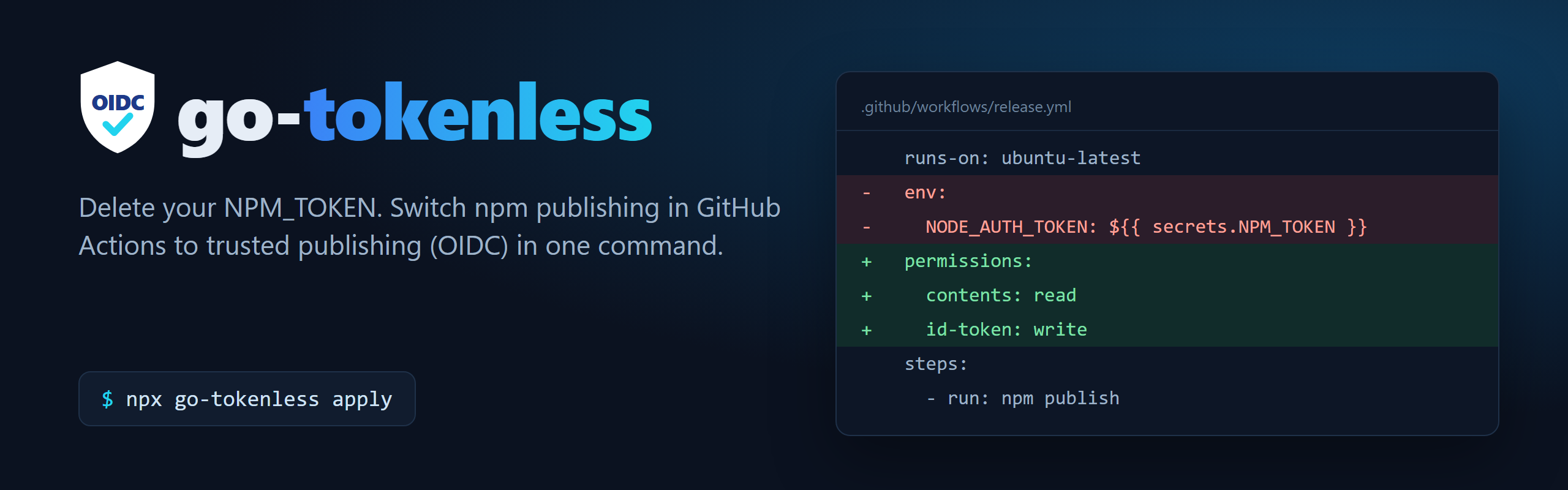




Delete your NPM_TOKEN. One command switches npm publishing in GitHub Actions to trusted publishing (OIDC). No long-lived token is stored anywhere, and every release gets a provenance badge.
npm is retiring token publishing: from January 2027 a token can no longer publish on its own (npm docs).
Contents
- Quick start
- What it changes
- Supported release setups
- Private packages
- Keep it tokenless in CI
- Use it with AI agents
- Options
- What it accesses
- What only you can do
- Troubleshooting
- Contributing
- License
From the root of the repository that publishes to npm:
npx go-tokenless          # 1. preview: lists every change and shows a diff, writes nothing
npx go-tokenless apply    # 2. edit the workflow and package.json files
Then follow the Next steps it prints: commit the change, connect the package to the workflow on npm, and delete the old secret. Needs Node 22.14+.
Only the lines that need to change are touched: comments, quoting and layout in your workflows are kept, and in package.json only the repository field is edited. Before writing, go-tokenless re-reads both versions and refuses if anything other than the migration would change.
| Problem in your release workflow | What go-tokenless does |
|---|---|
NODE_AUTH_TOKEN / NPM_TOKEN on the publish job (or the workflow) |
Removes it, so the secret can be deleted. npm prefers OIDC but falls back to a configured token, which would keep the old token in use |
| Job can't request an OIDC token | Adds permissions: id-token: write, keeping the permissions it had |
| npm older than 11.5.1 (Node 22 and below) | Adds npm install -g npm@^12, or moves Node < 22 to 24 |
actions/setup-node without registry-url |
Adds registry-url: https://registry.npmjs.org |
JS-DevTools/npm-publish below v4 |
Updates it to v4, which no longer requires a token |
A script writes _authToken to .npmrc |
Removes those lines |
repository missing or in the wrong form in package.json |
Sets git+https://github.com/<owner>/<repo>.git (with directory in monorepos) |
It stops with exit code 1 and writes nothing when a person needs to decide:
- Publishing reachable by outsiders: a publish job in a workflow started by
pull_request_target,issue_comment,workflow_runand similar triggers. Granting it OIDC would let a fork publish. - Self-hosted runners, which npm doesn't accept for trusted publishing.
repositorypointing at another repo.- YAML anchors. Edits could leak into other jobs.
- A hidden publish command: an npm token is passed but the publish command can't be found.
Dry runs (npm publish --dry-run) never count as publishing. Steps that publish to GitHub Packages, and GITHUB_TOKEN values, are left alone.
Example output
$ npx go-tokenless
go-tokenless: Ready to go tokenless. (acme/widgets)

Changes:
  .github/workflows/release.yml
    - publish: remove `NODE_AUTH_TOKEN` from job env
    - publish: grant `id-token: write`
    - publish: raise setup-node from Node 20 to 24 (trusted publishing needs Node 22.14+)
  package.json
    - widgets: add repository.url git+https://github.com/acme/widgets.git

Next:
  1. Run `npx go-tokenless apply` (or apply the diff above) and commit the changes on a branch.
  2. Add a trusted publisher for each package. With npm 11.15+ logged in with 2FA, run:
       npm trust github widgets --repo acme/widgets --file release.yml --allow-publish --yes
  3. Merge, then let the release workflow publish once. Check the new version shows a provenance badge.
  4. Delete the old publish token secret (`gh secret delete NPM_TOKEN`) and revoke the token on npmjs.com.
| Setup | Notes |
|---|---|
npm publish (incl. workspaces) |
|
pnpm publish / -r publish |
pnpm 10 hands off to npm; pnpm 11 needs 11.1.3+ |
Yarn Berry yarn npm publish |
Yarn 4.10.3+; remove npmAuthToken from .yarnrc.yml |
changesets (changesets/action) |
Works as is; if the first tokenless release can't authenticate, update to v2 |
| semantic-release | Needs @semantic-release/npm 13.1.0+ (semantic-release 25+) |
release-please + npm publish |
|
| Lerna / Nx release | Lerna 9+ |
| JS-DevTools/npm-publish | Updated to v4 |
| release-it | Also set npm.skipChecks: true |
Reusable workflows (workflow_call) |
npm checks the calling workflow's file name; a trust command is printed for every caller |
| Publishing inside scripts | Follows package.json scripts, ./scripts/*.sh, make <target> and local composite actions (uses: ./.github/actions/...), including working-directory |
Yarn 1 yarn publish, bun publish |
Flagged: those tools can't use trusted publishing yet, so switch to npm publish |
If your installs need private packages from your npm org, give the install steps a read-only token. Publish steps stay token-free:
npx go-tokenless apply --read-token NPM_READ_TOKEN - run: npm ci
+ env:
+ NODE_AUTH_TOKEN: ${{ secrets.NPM_READ_TOKEN }}
- run: npm publishEvery install step in the release workflow gets it, including separate build and test jobs. Create a granular token on npmjs.com with read-only access to your packages and save it with gh secret set NPM_READ_TOKEN.
Add the Action to CI. It fails the job if a token creeps back into a publish workflow, and the job summary lists the exact fixes:
# .github/workflows/ci.yml
jobs:
  tokenless:
    runs-on: ubuntu-latest
    permissions:
      contents: read
    steps:
      - uses: actions/checkout@v5
      - uses: continuous-actions/go-tokenless@v1
        # with:
        #   mode: report               # annotate only, never fail
        #   read-token: NPM_READ_TOKEN # if installs use a read-only token
It runs go-tokenless --json read-only and needs no token. Its status output is already-tokenless, ready, blocked or no-publish-workflow.
go-tokenless is built to be run by coding agents: --json output, clear exit codes, an MCP server and an Agent Skill. Ask your agent: "Move our npm publishing to trusted publishing."
| Client | Setup |
|---|---|
| Claude directory (claude.ai, Cowork, Claude Code) | Submitted to Anthropic's plugin directory and awaiting approval. Once listed: open the directory, search go-tokenless and select Add. It then syncs to Claude Code as go-tokenless@synced. Until then, use the marketplace command below |
| Claude Code (plugin: skill + MCP) | /plugin marketplace add continuous-actions/go-tokenless then /plugin install go-tokenless@continuous-actions |
| Claude Code (MCP only) | claude mcp add go-tokenless -- npx -y go-tokenless mcp |
| Gemini CLI | gemini extensions install https://github.com/continuous-actions/go-tokenless |
| Cursor, VS Code, others | Add the MCP config below |
| Any agent with skills | npx skills add continuous-actions/go-tokenless |
{ "mcpServers": { "go-tokenless": { "command": "npx", "args": ["-y", "go-tokenless", "mcp"] } } }MCP tools: plan_trusted_publishing (read-only) and apply_trusted_publishing (writes files; no git or network writes). It is listed in the MCP Registry as io.github.continuous-actions/go-tokenless. See also llms.txt and the Agent Skill.
npx go-tokenless [plan | apply | mcp] [options]
| Option | Description |
|---|---|
--json |
Print the full plan as JSON (status, changes, diff, findings, trust, nextSteps) |
--diff |
Include the diff in text output (always on for plan) |
--repo <owner/repo> |
GitHub repository, when origin isn't GitHub |
--cwd <dir> |
Repository root (default: current directory) |
--offline |
Skip the npm registry check that each package already exists |
--read-token <SECRET> |
Give install steps a read-only token from this secret (private packages) |
--npm-version <range> |
npm for the inserted upgrade step. Default ^12, pinned to one major so releases don't change under you. Other versions show a warning; below 11.5.1 is refused |
--npm-args "<args>" |
Extra arguments for every npm command it generates (upgrade step and npm trust) |
Exit codes: 0 ok · 1 blocked (needs a human fix) · 2 usage error · 3 unexpected error.
- Files: it reads
.github/workflows/*.yml,package.jsonfiles and related scripts in the repository you point it at.applyand theapply_trusted_publishingMCP tool write only to workflow andpackage.jsonfiles inside that repository. It never follows links out of the repository. - Network: read-only
GETrequests tohttps://registry.npmjs.org/<package>to check that each package already exists (--offlineor MCPoffline: trueturns this off). Nothing else is fetched or sent. There is no telemetry. - Never: it doesn't run repository code, read secrets or environment tokens, run git commands that change anything, or contact npm or GitHub on your behalf.
- Running it: the Claude Code plugin and the Gemini extension start the MCP server with
npx -y go-tokenless@<pinned version> mcp.
go-tokenless never touches your npm account, secrets or git history. After apply:
- Connect each package to the workflow: run the printed
npm trust github …commands (npm 11.15+, asks for 2FA), or go to npmjs.com → package → Settings → Trusted publishing. - New packages must be published once by hand first; npm can only connect a package that exists. The plan flags these.
- Delete the old secret and revoke the token after the first tokenless release.
Each error has its own page with causes and fixes: ENEEDAUTH, 404 on PUT, E422 repository.url, still using the token, and the 2FA-bypass notice.
| Error | Usual cause |
|---|---|
npm error code ENEEDAUTH |
No id-token: write, npm older than 11.5.1, or the workflow file name doesn't match the trusted publisher exactly (case-sensitive, with .yml) |
npm error 404 Not Found - PUT https://registry.npmjs.org/... |
Same as above, an environment mismatch, or no trusted publisher yet |
npm error code E422 … repository.url |
package.json repository doesn't match the GitHub repo. apply fixes the format |
| Publishing still uses the token | Something still sets NODE_AUTH_TOKEN, NPM_TOKEN, an .npmrc _authToken or .yarnrc.yml npmAuthToken. Run npx go-tokenless again to find it |
Issues and pull requests are welcome. Run corepack enable && yarn install && yarn check (typecheck, build and end-to-end tests). See AGENTS.md for how the code is laid out, and SECURITY.md to report a vulnerability.
MIT © continuous-actions