


- Full sound (triangle, pulse 1, pulse 2, noise, DMC), with visualization
- Controller
- MMC1 (1)
- UxROM (2)
- CNRom (3)
- MMC3 (4)
- AxRom (7)
- MMC2 (9)
- Mapper 19 (19)
- GxRom (66)
cargo run -r -- -r <rom>.nes
cpu2.rs implements a cycle-accurate 6502 CPU emulator. Unlike many high-level emulators that
execute a full instruction in a single step, cpu2.rs is memory-cycled. This means the CPU's state machine progresses one
clock cycle at a time, and every single cycle performs exactly one memory operation—either a read or a write.
The fundamental unit of execution in cpu2.rs is the tick() method. Each call to tick() represents one clock cycle
of the 6502.
- Single Memory Access per Cycle: In alignment with the real 6502 hardware, every cycle is characterized by a memory access. Even cycles that appear to be "internal" to the CPU on paper actually perform a read (often a redundant read of the next opcode or a stack byte) which is discarded.
- The CPU maintains its internal state (registers, current opcode, current cycle within that opcode)
across
tick()calls. This allows it to be perfectly synchronized with other hardware components like the PPU or APU. - An instruction is considered finished when the
finishedflag is set during atick(). The next call totick()will then fetch the next opcode.
Cpu2<T>: Holds the CPU registers (A,X,Y,S,PC,P) and the execution state (current_opcode,current_cycle,finished).tick(&mut self, config: &Config) -> u8: The primary entry point for advancing the CPU by one clock cycle. It uses a large match statement on thecurrent_opcodeand a nested match oncurrent_cycleto determine the specific action for the current cycle.run_one_instruction(&mut self, config: &Config) -> u8: A helper method that callstick()repeatedly until the current instruction is fully executed, returning the total number of cycles consumed.
The accuracy of the cycle-by-cycle implementation is verified using the 6502 Single Step tests (commonly referred to as the "Harte" tests in this codebase).
- Verification Scope: These tests ensure that for every opcode, the CPU performs the exact sequence of reads and writes to the correct addresses with the correct values, cycle by cycle.
- Status:
cpu2.rssuccessfully passes these comprehensive Single Step tests, confirming its behavior matches real 6502 hardware at the bus level.
In the larger emulator context, cpu2.rs is used when high precision and bus-level accuracy are required. It can be
stepped cycle-by-cycle alongside the APU and PPU to ensure perfect timing synchronization, which is critical for many
NES games that rely on precise mid-scanline timing or specific APU behavior.
ppu2.rs implements the NES Picture Processing Unit (PPU) by simulating its internal logic as closely as possible to the official hardware diagrams (such as the one found on NesDev). Unlike high-level renderers that work scanline-by-scanline, ppu2.rs operates at the "dot" (pixel clock) level.
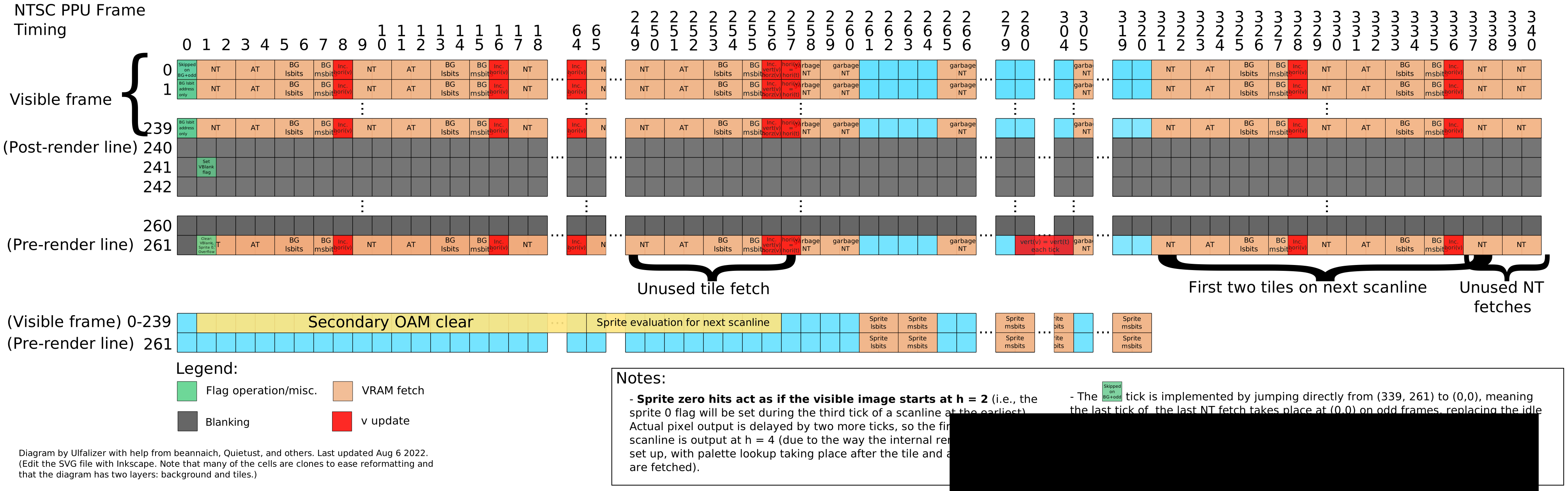
The core of the implementation is a large pre-calculated array of events which is computed in this function:
- Event Array: An array of
261 * 340(the dimensions of a NTSC NES frame) elements is created during initialization viainit_events(). - Dot-by-Dot Execution: Every time the PPU
tick()function is called, it lookups the event(s) associated with the current dot (xandscanline). - Bitmask Events: Each entry in the array is a bitmask of actions to perform, such as:
NT/AT: Fetch Name Table or Attribute Table byte.BG_LSBITS/BG_MSBITS: Fetch Pattern Table (tile) bits.INC_HORIZ_V/INC_VERT_V: Increment the internal scroll registers (vandt).SPRITE_EVALUATION: Check which sprites belong on the next scanline.
The PPU uses 16-bit shift registers to handle smooth scrolling and pixel output, which ppu2.rs replicates exactly:
- Pattern Shifters:
pattern_shift_lowandpattern_shift_highhold the 2 bits of color data for the next 16 pixels. - Attribute Shifters:
attr_shift_lowandattr_shift_highhold the palette selection bits. - Fine-X Scrolling: The
fine_xscroll value acts as a selector for which bit in the 16-bit shifters is currently being "emitted" as the pixel. - Reloading: Every 8 dots, the shifters are updated with new data fetched from VRAM. The implementation ensures that bits are shifted only when rendering is enabled and during specific windows (visible area and pre-fetch periods), preventing graphical glitches like the "left-edge black bar."
Sprite handling is split into two distinct phases, matching the hardware's 341-dot cycle:
- Evaluation (Dots 65–256): The PPU scans the 256-byte primary OAM (Object Attribute Memory) to find up to 8 sprites that intersect the next scanline. These are copied to a 32-byte
oam2(Secondary OAM). - Fetching (Dots 261–320): The PPU fetches the actual tile data for the 8 sprites found during evaluation.
- Latches: The fetched sprite data is stored in
sprite_latches. During the visible part of the next scanline, these latches are checked to see if any sprite pixel should override the background pixel.
- Internal Registers: It uses the standard
v(current VRAM address) andt(temporary VRAM address) register logic for scrolling. - VBlank and NMI: The
SET_VBLANK_FLAGevent is precisely timed (triggered at scanline 241, dot 0) to ensure compatibility with sensitive timing tests like Branch Basics. - Sprite 0 Hit: The implementation includes a specific
sprite_0_hit_delayto account for the pipeline delay between the PPU detecting a collision and the CPU seeing the flag in the status register.
- Initialize: Generate the
eventstable once. - Tick:
- Get the current event mask.
- Advance shift registers.
- Perform VRAM fetches (NT, AT, Tile).
- Calculate pixel color using current shift register states + Fine-X.
- Update scrolling registers (
v) if the event calls for an increment or reset. - Handle Sprite Evaluation/Fetching for the next line.
- Emit the final pixel to the
screenbuffer.
- Repeat: 89,342 times per frame.