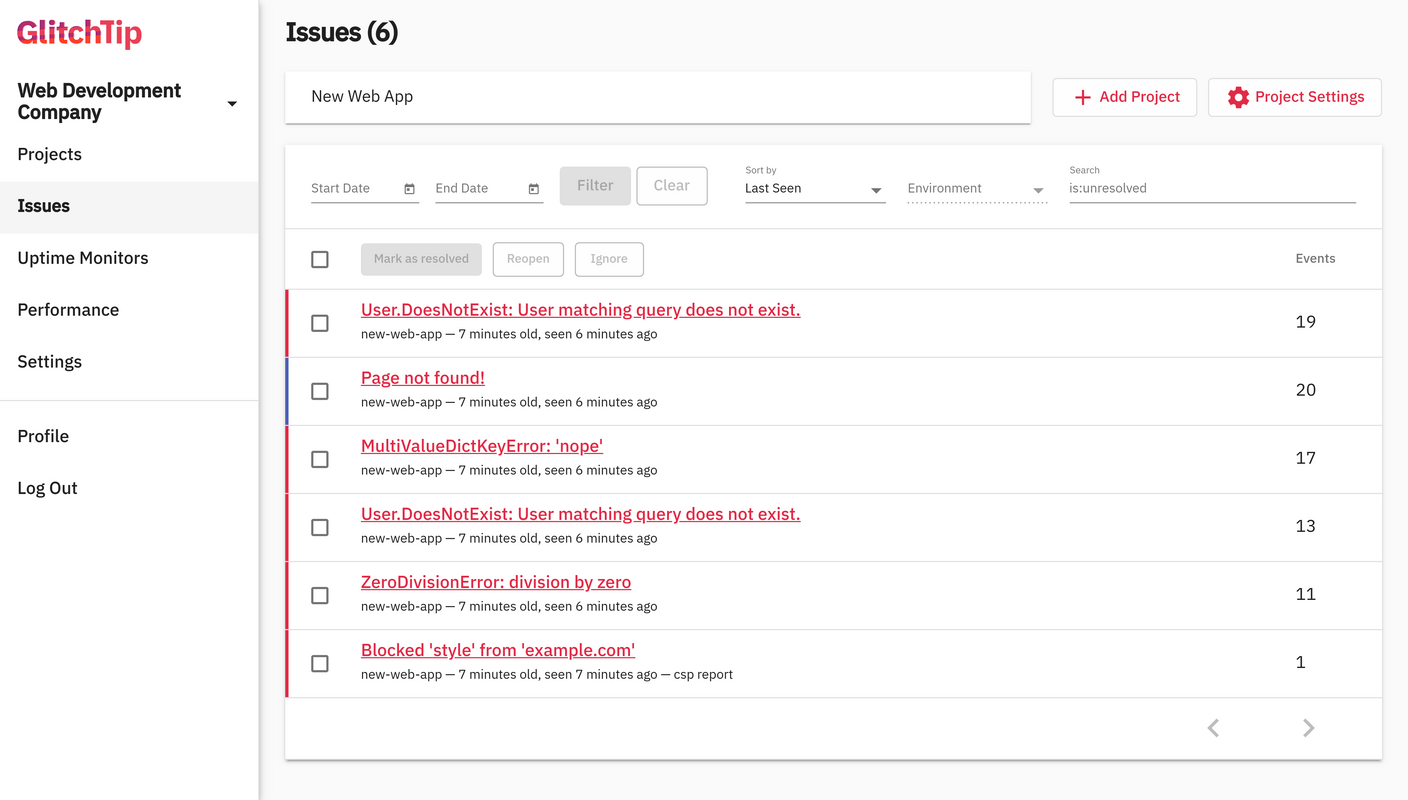
GlitchTip is a Sentry-compatible error-tracking service that helps you find and fix bugs faster. It is a self-hosted alternative to Sentry.
Upstream repositories:
- Backend: https://gitlab.com/glitchtip/glitchtip-backend
- Frontend: https://gitlab.com/glitchtip/glitchtip-frontend
- Changelog: see
CHANGELOGin the backend repo
The deployment consists of the following components in OpenShift (defined in openshift/template.autoscaler.yaml):
| Component | Type | Purpose |
|---|---|---|
| glitchtip-web | Deployment | Serves the API and frontend (granian ASGI server) |
| glitchtip-worker | Deployment | Processes async tasks via django-tasks (runworker --scheduler) |
| glitchtip-notification-cleaner | CronJob | Cleans the notification table daily (04:32 UTC) |
| KEDA ScaledObject | Autoscaler | Scales workers based on event ingest rate (prometheus query) |
- 3 replicas (default), rolling update (maxUnavailable: 0)
- Port 8000 (granian), metrics on port 9090
- Init containers: DB migration (
bin/run-migrate.sh), API user creation (appsre/create-api-users.py) - TCP-based readiness, startup, and liveness probes
- 3-15 replicas, auto-scaled by KEDA based on event ingest rate
- Runs
./manage.py runworker --scheduler --health-check-file /tmp/worker_health --schedulerreplaces celery-beat (runs on every worker, coordinated via DB backend)- File-based liveness/readiness probes: checks
/tmp/worker_healthwas modified within last 15 seconds
| Secret | Keys |
|---|---|
glitchtip-rds |
db.host, db.password, db.name, db.user |
redis-url |
redis.url |
smtp |
server, password, username, port, require_tls |
glitchtip-s3 |
aws_access_key_id, aws_secret_access_key, bucket, endpoint (optional) |
We apply patches and ship custom scripts on top of the upstream GlitchTip image.
Applied during the Docker build (Dockerfile):
| Patch | File | Purpose |
|---|---|---|
00-skip-user-invitation-process |
apps/organizations_ext/api.py |
Skips invitation emails and auto-creates Django users when adding members to an organization |
04-aws-s3-endpoint-url |
glitchtip/settings.py |
Prepends https:// to AWS_S3_ENDPOINT_URL |
08-ingest-prometheus-middleware |
glitchtip/ingest_asgi.py |
Restores PrometheusBeforeMiddleware / PrometheusAfterMiddleware on ingest endpoints (stripped by upstream for performance) |
09-prometheus-metrics |
apps/observability/metrics.py |
Adds glitchtip_events prometheus gauge with project and organization labels; restores glitchtip_projects gauge |
| Script | Used by | Purpose |
|---|---|---|
bin/run-worker.sh |
Worker deployment | Overrides upstream to add --health-check-file /tmp/worker_health for k8s probes |
appsre/create-api-users.py |
Init container | Creates superusers and API tokens from APPSRE_API_USER_* env vars |
appsre/cleanup-notifications.py |
CronJob | Deletes all notification records to prevent unbounded table growth |
| Metric | Type | Labels | Source |
|---|---|---|---|
glitchtip_organizations |
Gauge | — | upstream |
glitchtip_projects |
Gauge | organization |
patch 09 |
glitchtip_events |
Gauge | project, organization |
patch 09 |
These are provided by django-prometheus and require the middleware to be active (patch 08 restores this for ingest endpoints):
django_http_requests_total_by_view_transport_method_total— request count per view (used by KEDA autoscaler)django_http_requests_latency_seconds_by_view_method_bucket— latency histogram per viewdjango_http_responses_total_by_status_total— response count per HTTP statusdjango_http_requests_total_by_transport_total— request count by transport
Exposed on port 9090 (configured via GRANIAN_METRICS_ENABLED=1, GRANIAN_METRICS_PORT=9090).
All dashboards are in grafana/:
| Dashboard | File | What it monitors |
|---|---|---|
| Main | grafana-dashboard.yml |
HAProxy availability, events/min, RDS connections/IOPS/latency, ElastiCache, pod resources, API latency percentiles |
| Django | grafana-django.yml |
HTTP request/response rates, latency percentiles, top 10 endpoints, response body sizes |
| Projects | grafana-project.yml |
Per-project event counts and rates (uses glitchtip_events from patch 07) |
| SLO | grafana-slo.yml |
Service level objective tracking |
Recommended: run the glitchtip-upgrade Claude Code skill (.claude/skills/glitchtip-upgrade/)
to walk through the steps below — it checks out the Renovate/Mintmaker PR (or creates a branch),
bumps the version and digest, summarizes the upstream changelog (flagging any authN/authZ changes
that need manual staging verification), verifies/regenerates patches/, and keeps this section and
the "Customizations" table current.
- Check available versions at glitchtip-frontend images
- Read the upstream
CHANGELOGfor breaking changes between current and target version - Update
GLITCHTIP_VERSIONinDockerfile - Verify all patches still apply — build locally with
make build - Update patches if they fail to apply (upstream code changed)
- Push to branch, create PR
- Changes deploy automatically to staging
- CI/CD acceptance tests run automatically in
glitchtip-stage - After acceptance tests pass, promoted to production manually via MR in app-interface.
After every upgrade, manually verify:
- Build succeeds — all patches apply cleanly
- OIDC / SSO login works — log in via the web UI
- API user creation works —
init-api-usersinit container completes successfully - Event ingestion works — send a test event via Sentry SDK and verify it appears in the UI
- Worker pods become ready — health check file
/tmp/worker_healthis being written - Web pod access logs — verify web POD writes access logs
- Prometheus metrics present:
glitchtip_events(per project/org)glitchtip_organizationsglitchtip_projectsdjango_http_requests_total_by_view_transport_method_totalforeventsviews (used by KEDA autoscaler)
- KEDA autoscaler — check
ScaledObjectstatus, verify worker scaling on load - Grafana dashboards — all 4 dashboards load and show data
- Notification cleaner CronJob — runs successfully on schedule
- Acceptance tests pass — automated in CI, but verify in staging
Located in acceptance/, run with pytest. Tests cover:
- Organization CRUD
- Team CRUD
- Project CRUD (including team assignment)
- Project alerts (webhook type, create/update/delete)
- User invite, role update, team assignment
Tests run in order (via pytest-order) and clean up after themselves.
Only runs as a Job against a real GlitchTip instance
(openshift/acceptance.yaml, wired via app-interface's
saas-glitchtip-test to glitchtip-stage after every deploy) — nobody runs
it locally.
Environment variables:
| Variable | Default | Purpose |
|---|---|---|
GLITCHTIP_URL |
http://web:8080 |
GlitchTip instance URL |
GLITCHTIP_API_USER_EMAIL |
glitchtip@qontract-reconcile.org |
API user for test auth |
GLITCHTIP_API_USER_TOKEN |
token |
Bearer token for API calls |
django-tests/test_webhook_payload_contract.py guards against upstream
GlitchTip changing the shape of the JSON it POSTs to webhook alert
recipients (this bit us once: glitchtip-jira-bridge silently rejected
every alert for months after GlitchTip dropped a field and started omitting
another). It's a plain unittest test against the real, pinned
apps/alerts/webhooks.py — it builds an in-memory Issue and mocks only
the outbound aiohttp transport, then asserts on the exact dict that would
be sent as JSON. It's COPY'd into apps/alerts/tests/ inside the
Dockerfile's test stage and run by make test, which Konflux already
builds on every PR (.tekton/glitchtip-main-pull-request.yaml,
target-stage: test) — no live instance or network needed. It's a unit
test rather than a live E2E acceptance test because there's no network path
from the real acceptance Job (see above) back to a capture endpoint
without new permanent public-facing infrastructure.
# start all services (requires external network "qontract-development")
docker-compose up

# build images locally
make build

# run linters and type checks
make test
The docker-compose.yml starts postgres, redis, web, worker, and init-api-users. Web is available at http://localhost:8000.
Default local users:
| Password | Token | |
|---|---|---|
admin@admin.org |
rev9tbk!YUE.wfy8uku |
— |
glitchtip@qontract-reconcile.org |
— | token |