
Formally verified perpetual futures on Solana with four novel DeFi primitives.
A perps protocol that introduces self-repaying perpetuals, power perpetuals (squeeth), portfolio margining, and gradual deleveraging — backed by 18 machine-checked Lean 4 proofs, academic pricing models, and MEV-resistant batch auctions. 132 KB binary, no Anchor runtime.
Program ID:
8s677udBiKHkCNYzGEroenfN23k1vQjqR3JQvHjZcDWg
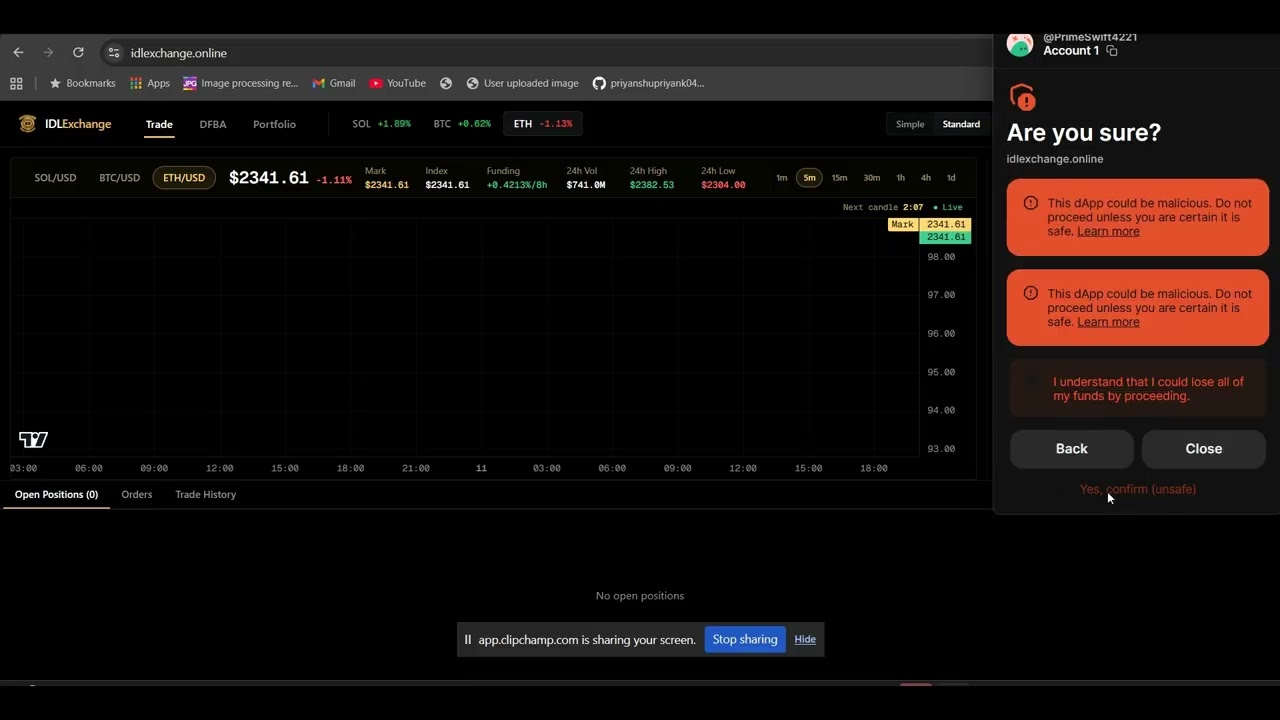
Click the image above to watch the demo on YouTube
Perpetual futures dominate crypto derivatives — $85.7 trillion in volume (2025, CoinGlass). Yet the infrastructure is fundamentally broken:
- $150 billion liquidated from traders in 2025 alone (CryptoSlate). Binary liquidation wipes entire positions at the worst possible moment.
- 19.26% annualized funding cost (Gate.io, 2025) — a silent tax that compounds against every open position.
- $3.21 billion vanished in 60 seconds during the October 2025 flash crash, wiping 1.6 million traders (Amberdata).
- Linear-only payoffs force traders into constant gamma hedging. No protocol offers convex exposure natively.
Existing Solana perps (Jupiter, Drift) are functional but structurally identical. The problem is not execution — it's the contract design itself. These four primitives address the structural failures.
Collateral yield offsets funding costs. Positions collateralized with JLP (~17-20% APY) or mSOL (~6% APY) use the yield to pay funding, often making the position net-positive.
Traditional Perp                    IDLExchange
┌─────────────────┐                ┌─────────────────┐
│ Collateral: SOL  │                │ Collateral: JLP  │
│ Funding: -0.012% │                │ Funding: -0.012% │
│ Yield:    0.000% │                │ Yield:   +0.018% │
│ ─────────────── │                │ ─────────────── │
│ Net:     -0.012% │                │ Net:     +0.006% │
│    (you pay)     │                │    (you earn)    │
└─────────────────┘                └─────────────────┘
How it works: The funding crank (settle_funding instruction) computes per-position effective rates. For yield-bearing collateral, the backend's funding-crank service subtracts the 8h yield accrual from the raw funding rate before settlement. On-chain, collateral is directly adjusted — no separate debt token.
Supported collateral:
| Asset | Haircut | Yield Source | Typical 8h Yield |
|---|---|---|---|
| SOL | 0% | None | 0 bps |
| JLP | 25% | Jupiter LP fees | ~5.5 bps |
| mSOL | 18% | Staking rewards | ~0.19 bps |
Contracts indexed to price^p, delivering options-like convexity without expiry or strike management. Based on Paradigm Research, "Power Perpetuals" (2024).
Example: If SOL moves +10%, a standard perp gains +10%. A power perp (p=2) gains +21% — because PnL = (exit² - entry²) / entry².
On-chain implementation: The Position struct stores power_milli (u64):
1000→ standard perp (p=1.0), linear PnL2000→ squeeth (p=2.0), quadratic PnL viacalculate_pnl_power()500→ sqrt perp (p=0.5), dampened exposure (stretch)
Squeeth positions pay 2x spread as a convexity premium. Max leverage capped at 5x (vs 10x standard) for risk containment.
Risk-based margin across correlated positions. Instead of liquidating each position independently, the protocol stress-tests the entire portfolio.
Individual Margin (status quo)        Portfolio Margin (IDLExchange)
┌───────────────────────────┐        ┌───────────────────────────┐
│ Long  SOL:  $100 margin   │        │                           │
│ Short BTC:  $100 margin   │        │ Worst-case scenario:      │
│ ───────────────────────── │        │   SOL -15%, BTC +5%       │
│ Total:      $200 required │        │ Portfolio loss: $142.50   │
│                           │        │ ───────────────────────── │
│ No hedging benefit.       │        │ Savings: $57.50 (28.8%)   │
└───────────────────────────┘        └───────────────────────────┘
Scenario engine runs 15 correlated stress tests (combinations of -15% to +15% moves across SOL/BTC/ETH). Portfolio margin = max drawdown across all scenarios.
Correlation matrix (empirical, hardcoded):
| SOL | BTC | ETH | |
|---|---|---|---|
| SOL | 1.00 | 0.75 | 0.70 |
| BTC | 0.75 | 1.00 | 0.85 |
| ETH | 0.70 | 0.85 | 1.00 |
Severity-based partial liquidation replaces binary all-or-nothing wipeouts. The protocol closes proportional slices based on how deep the position is underwater.
Margin Ratio        Action               What Happens
━━━━━━━━━━━━━━━━━━━━━━━━━━━━━━━━━━━━━━━━━━━━━━━━━━━━━
  > 5.0%            Safe                 No action
  4.0% – 5.0%      Zone 1: Close 25%    Partial deleverage
  3.0% – 4.0%      Zone 2: Close 50%    Partial deleverage
  2.0% – 3.0%      Zone 3: Close 75%    Partial deleverage
  < 2.0%            Full Liquidation     Position closed
Why it matters: During the Oct 2025 crash, 1.6M traders were fully liquidated in a cascade. Gradual deleveraging gives traders a recovery window — a 25% trim at 4.5% margin is survivable; a 100% wipeout at 4.9% is not.
These are not independent features — they form an interlocking system:
                    ┌─────────────────────┐
                    │   Self-Repaying     │
                    │   (yield offsets    │
                    │    funding costs)   │
                    └──────────┬──────────┘
                               │
              Yield-bearing collateral
              keeps margin healthier
                               │
                    ┌──────────▼──────────┐
                    │   Gradual           │
                    │   Deleveraging      │◄──── Fewer full liquidations
                    │   (partial close    │      = smaller cascade risk
                    │  by severity zone)  │
                    └──────────┬──────────┘
                               │
              Surviving positions contribute
              to portfolio-level hedging
                               │
                    ┌──────────▼──────────┐
                    │    Portfolio        │
                    │     Margining       │◄──── Correlated positions
                    │   (cross-position   │      offset each other
                    │   stress testing)   │
                    └──────────┬──────────┘
                               │
              Freed margin capital enables
              more expressive positions
                               │
                    ┌──────────▼──────────┐
                    │   Power Perpetuals  │
                    │   (convex payoffs   │
                    │    without options) │
                    └─────────────────────┘
Self-repaying keeps positions alive longer → gradual deleveraging handles the ones that do decline gracefully → portfolio margining nets correlated risk across surviving positions → freed capital enables power perps with their higher margin requirements. Each primitive makes the others more effective.
The protocol's pricing and risk engines are not heuristic — they implement published models from quantitative finance:
| Model | Application | Formula | Reference |
|---|---|---|---|
| Avellaneda-Stoikov | Dynamic spread | r = s - qγσ²*(T-t), δ = γσ²(T-t) + (2/γ)*ln(1+γ/k) | Avellaneda & Stoikov (2008), Operations Research |
| VPIN | Toxicity scoring | VPIN = |V_buy - V_sell| / V_total | Easley, Lopez de Prado & O'Hara (2012) |
| CUSUM | Regime detection | Sequential change-point detection for volatility shifts | Page (1954) |
| RL Funding | Predictive rates | 24h basis variance minimization, not just current basis zeroing | Cartea, Jaimungal & Walton (2023) |
| DFBA | MEV resistance | Uniform clearing price over 15s batches, 8 sharded queues | Budish, Cramton & Shim (2015) |
| Power Perps | Convex payoffs | PnL = (exit^p - entry^p) / entry^p * size | Paradigm Research (2024) |
How academic models map to the four primitives:
- Self-Repaying uses the RL funding model — the predictor doesn't just zero current basis, it minimizes 24h basis variance. This creates smoother funding rates that interact cleanly with yield offsets.
- Power Perps are priced through the Avellaneda-Stoikov engine with doubled spread for squeeth (convexity premium), and VPIN toxicity scoring adjusts the premium in real-time.
- Portfolio Margining runs stress scenarios using empirical correlations — the scenario engine is a discretized version of Value-at-Risk (VaR) stress testing.
- Gradual Deleveraging replaces the binary threshold with a severity curve. The liquidator uses the same Avellaneda-Stoikov reservation price to determine optimal partial-close sizing.
Three independent verification layers catch different bug classes. The .qedspec is the single source of truth — all harnesses and theorems are generated from it.
Every safety property is mathematically proven to hold across every state transition:
| Property | Theorems | What It Proves |
|---|---|---|
collateral_conservation |
6 | Collateral is always non-negative across all handlers |
oi_tracking |
3 | Open interest fields never go negative |
oi_cap |
1 | Total OI never exceeds max TVL (80% cap) |
leverage_bounds |
1 | Position notional bounded by max_leverage * deposit |
funding_bounds |
1 | Funding rate stays within +-0.5% per 8h |
no_overflow |
6 | All arithmetic is checked — wrapping is impossible |
Bug found by formal verification: The original leverage_bounds property was proven FALSE — protocol fees reduce collateral below the original deposit while notional is computed from the full deposit. The corrected property tracks the pre-fee deposit amount. This is the exact class of bug that audits miss and formal methods catch.
Random property-based testing at ~1000 cases per harness:
- 18 preservation tests (each property x each handler)
- 5 guard rejection tests (invalid inputs always rejected)
- 3 overflow detection tests (wrapping arithmetic caught)
- 1 state machine sequence test (random operation chains)
- 1 operation dispatcher
Bounded model checking via CBMC exhaustively verifies all inputs within bounds:
- 4 invariant preservation proofs
- 2 guard enforcement proofs
- 2 cover properties (reachability)
| Parameter | Value | Constant |
|---|---|---|
| Max Leverage | 10x (5x for power perps) | DEFAULT_MAX_LEVERAGE |
| Maintenance Margin | 5% | MAINTENANCE_MARGIN_BPS = 500 |
| Protocol Fee | 0.1% | DEFAULT_PROTOCOL_FEE_BPS = 10 |
| Max Funding Rate | +-0.5% per 8h | MAX_FUNDING_RATE_BPS = 50 |
| Liquidation Bonus | 5% | LIQUIDATION_BONUS_BPS = 500 |
| DFBA Price Cap | Pyth +-0.3% | PYTH_CAP_BPS = 30 |
| Oracle Staleness | 60s max | MAX_ORACLE_AGE_SECONDS |
| Oracle Confidence | 1% max | MAX_ORACLE_CONFIDENCE_BPS = 100 |
| Oracle Divergence | 2% (Pyth vs Switchboard) | ORACLE_DIVERGENCE_BPS = 200 |
| PSF Fee Share | 10% of protocol fees | PSF_FEE_SHARE_BPS = 1000 |
| OI Cap | 80% of max TVL | OI_CAP_PCT = 80 |
| Min Spread | 5 bps | MIN_SPREAD_BPS = 5 |
Certain protocol behaviors cannot be replicated from source code alone. They depend on live oracle state, historical data, or off-chain observation windows:
The spread engine requires a 120-observation price ring buffer (fed every ~15s by the circuit breaker) to compute σ² (price variance in USD²/second). A fresh deployment starts with zero observations — the engine falls back to MIN_SPREAD_BPS (5 bps) until the buffer fills (~30 minutes).
The risk aversion parameter γ is calibrated so γ*s ≈ 0.01 at the current mid price. This is not a static constant — it adjusts dynamically. There is no config file; the calibration is emergent from the live price feed.
The funding predictor maintains a 24-hour basis observation history with skew, OI imbalance, and basis measurements. It minimizes predicted basis variance over the next 24h, not just the current basis. This means:
- A fresh deployment produces the raw (mark - index) / index rate
- After 24h of observations, the controller activates and adjusts rates
- The adjustment depends on the specific sequence of basis observations — it is path-dependent
The weights are not static. They evolve based on observed market microstructure. Two deployments with different initial trading patterns will produce different funding rate behaviors.
VPIN (Volume-Synchronized Probability of Informed Trading) maintains a rolling window of 50 batch results. The spread multiplier depends on this history:
- VPIN > 0.7 → 1.5x spread (toxic flow detected)
- VPIN < 0.3 → 0.8x spread (noise flow, tighten)
- Between → 1.0x
This history is in-memory and non-persistent. A service restart resets VPIN to the neutral 0.5 default.
Self-repaying funding offsets depend on the live JLP price trajectory relative to each position's entry price. The 8h yield is computed as:
yield_8h = ((current_jlp_price - entry_jlp_price) / entry_jlp_price) * (8h / elapsed)
This is position-specific and time-specific. Two identical positions opened at different JLP prices will have different effective funding rates. The yield data comes from Jupiter's live price feed — it cannot be mocked or replicated from static data.
The 15 stress scenarios use a static correlation matrix (reproducible), but the portfolio margin result depends on the specific set of open positions at query time. Two wallets with different position compositions will produce different savings percentages. The worst-case scenario label (e.g., "SOL -15%, BTC +5%") changes based on which positions are open.
Large DFBA orders (>$10K notional) use commit-reveal to prevent frontrunning. The commitment hash is SHA256(user || price || size || nonce). The nonce is generated client-side and never stored on-chain — only the hash is. If a user loses their nonce before reveal, the order is unrecoverable. This is by design.
| Layer | Technology | Notes |
|---|---|---|
| Blockchain | Solana Mainnet | ~400ms slot time |
| On-Chain Program | Rust, solana-program v1.18.26 |
No Anchor runtime, 132 KB binary |
| Formal Verification | Lean 4 (v4.30.0-rc2), QEDGen | 18 theorems, 0 sorry |
| Property Testing | proptest, Kani (CBMC) | 28 + 8 harnesses |
| Backend | TypeScript, Express, pino | 8 concurrent services |
| Frontend | React 18, Vite, TradingView | Phantom + Privy wallets |
| Oracle | Pyth Network (pull, Hermes) | Switchboard fallback |
| Build | cargo build-sbf, opt-level "z", LTO fat, strip |
Minimal binary |
| Detail | Value |
|---|---|
| Program ID | 8s677udBiKHkCNYzGEroenfN23k1vQjqR3JQvHjZcDWg |
| Network | Solana Mainnet |
| Binary Size | 132 KB |
| Build Profile | opt-level = "z", lto = "fat", strip = true, panic = "abort" |
| Upgrade Authority | Deploy keypair |
Oracle Feeds (Mainnet):
| Market | Pyth Account |
|---|---|
| SOL/USD | 7UVimffxr9ow1uXYxsr4LHAcV58mLzhmwaeKvJ1pjLiE |
| BTC/USD | 4cSM2e6rvbGQUFiJbqytoVMi5GgghSMr8LwVrT9VPSPo |
| ETH/USD | 42amVS4KgzR9rA28tkVYqVXjq9Qa8dcZQMbH5EYFX6XC |
atomic/
├── programs/atomic_perps/
│   ├── src/
│   │   ├── lib.rs                 # Entrypoint, discriminator routing
│   │   ├── state.rs               # GlobalConfig (492B), Position (187B), Order, Queue
│   │   ├── constants.rs           # All protocol parameters
│   │   ├── errors.rs              # Error codes
│   │   ├── events.rs              # CPI event emission
│   │   ├── utils/
│   │   │   └── math.rs            # PnL, health, haircuts, spread, power PnL
│   │   └── instructions/
│   │       ├── initialize.rs      # One-time setup
│   │       ├── atomic_open.rs     # Open position (supports power_milli)
│   │       ├── atomic_close.rs    # Close position (power-aware PnL)
│   │       ├── liquidate.rs       # Gradual deleveraging + power PnL
│   │       ├── settle_funding.rs  # 8h funding settlement
│   │       ├── update_config.rs   # Admin config updates
│   │       ├── migrate_config.rs  # V1→V4 state migration
│   │       ├── place_order.rs     # DFBA order placement
│   │       ├── cancel_order.rs    # DFBA order cancellation
│   │       ├── execute_batch.rs   # DFBA batch clearing
│   │       └── init_queue_shard.rs # DFBA queue initialization
│   ├── formal_verification/
│   │   ├── Spec.lean              # Generated from .qedspec
│   │   ├── Proofs.lean            # 18 hand-written theorems
│   │   └── lean_solana/           # QEDGen support library
│   └── atomic_perps.qedspec       # Formal spec (source of truth)
├── backend/src/
│   ├── index.ts                   # Service orchestrator
│   ├── services/
│   │   ├── api.ts                 # REST + WebSocket API
│   │   ├── liquidator.ts          # Position health scanner
│   │   ├── funding-crank.ts       # 8h funding settlement
│   │   └── dfba-crank.ts          # 15s batch clearing
│   └── lib/
│       ├── health.ts              # Margin ratio + deleverage zones
│       ├── spread.ts              # Avellaneda-Stoikov engine
│       ├── funding.ts             # RL-enhanced funding rates
│       ├── dfba.ts                # Batch clearing + VPIN
│       ├── portfolio-margin.ts    # 15-scenario stress testing
│       ├── ix-builders.ts         # Instruction construction
│       └── decode.ts              # On-chain account deserialization
├── app/src/
│   ├── pages/                     # Trade, Portfolio, DFBA, Intro
│   ├── components/                # TradePanel, PositionsTable, PowerPerpScene, etc.
│   └── hooks/                     # usePosition, useFundingRate, usePortfolioHealth
├── .github/workflows/verify.yml   # CI: Lean + Proptest + Kani
└── Cargo.toml                     # Workspace config
MIT