
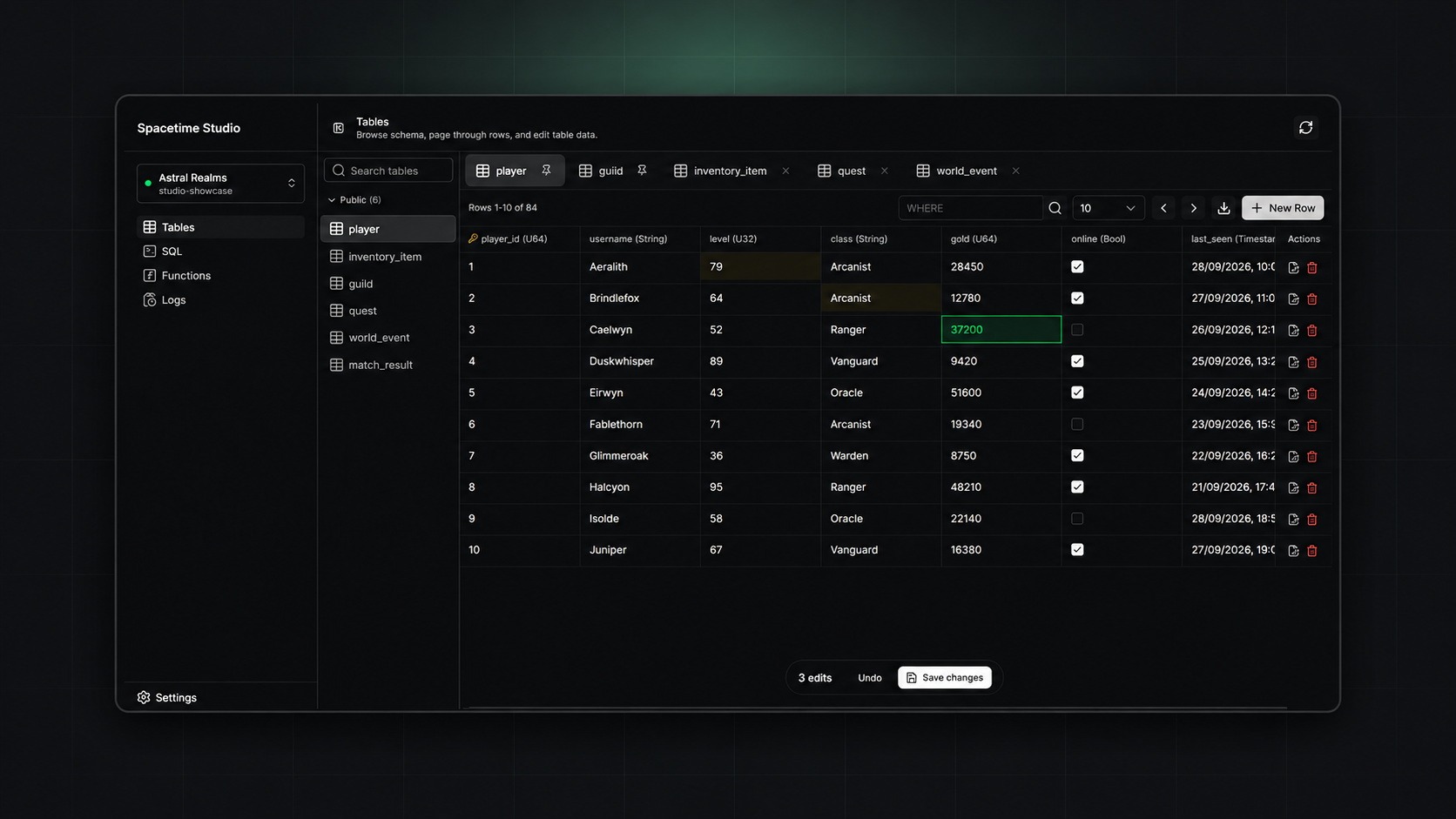


Spacetime Studio is a desktop admin client for SpacetimeDB. It gives you a lightweight way to connect to a local or hosted SpacetimeDB instance, inspect schemas, browse and edit table data, run raw SQL, view reducers/functions, and tail database logs.
Spacetime Studio supports Windows, macOS, and Linux. GitHub Actions builds installers for all three platforms whenever changes are pushed to main. Release installers are published on the GitHub Releases page.
- Save connection profiles for local or hosted SpacetimeDB databases.
- Reuse the token and server list from your
spacetimeCLI login instead of pasting tokens. - Store bearer tokens in the operating system keychain instead of the frontend.
- Mark a connection read-only so row edits, reducer calls, and writing SQL are blocked.
- See which saved servers are online and switch between them from the sidebar.
- Inspect tables, columns, readable types (Identity, Timestamp,
Option<T>, named structs), primary keys, and schedule tables. - Browse table rows with pagination and a total row count, and export them to CSV or JSON.
- Create, update, and delete rows. Only changed columns are written, and an edit or delete is refused unless it matches exactly one row.
- Run SQL in a console with history, multi-statement results, and CSV/JSON export.
- Browse and call reducers, with lifecycle and scheduled reducers labelled.
- Stream database logs live, filtered by level or text.
- Tauri 2 for the desktop shell and native Rust backend.
- Vue 3 and TypeScript for the frontend.
- Vite for development and frontend builds.
- Nuxt UI and Tailwind CSS for the interface.
- Rust
reqwestfor SpacetimeDB HTTP API calls. - Rust
keyringfor secure token storage.
There are two ways to get Spacetime Studio:
- Download a release for the easiest setup on Windows, macOS, or Linux.
- Build from source if you want to build locally, use the latest development version, or contribute.
Installers for Windows, macOS, and Linux are available from the repository's GitHub Releases page. Choose the package for your operating system: Windows provides an .msi installer and a setup .exe, macOS provides a .dmg, and Linux provides .deb and AppImage packages.
- Open the repository's GitHub Releases page.
- Download the installer for your operating system from the latest release.
- Install Spacetime Studio.
- Launch the app and connect to your SpacetimeDB database.
This path does not require Node.js, Rust, or compiling the project yourself.
Use this path if you want to build and run Spacetime Studio locally on Windows, macOS, or Linux, use the latest development version, or contribute to the project.
Install these before running the app:
- Node.js and npm.
- Rust.
- The platform dependencies required by Tauri 2 for your operating system.
- A running SpacetimeDB host to connect to.
For a local SpacetimeDB server, the default connection URL in the app is:
http://localhost:3000You will also need the database name or database identity for the module you want to inspect.
Clone the repository:
git clone <repository-url>
cd spacetime-studio
Install JavaScript dependencies:
npm installRun the desktop app in development mode:
npm run tauri devTauri will start the Vite dev server and open the Spacetime Studio desktop window.
- Open Spacetime Studio.
- Click Add connection, either on the Tables page or in the connection picker at the top of the sidebar.
- Enter a friendly profile name.
- Pick a host:
- Local server uses
http://localhost:3000. - Hosted in Maincloud uses
https://maincloud.spacetimedb.com. - Self-hosted lets you enter the public URL of a server you run yourself, for
example a Railway, Fly, or VPS deployment. A bare domain such as
my-app.up.railway.appis fine;https://is assumed when you leave the scheme off, except for loopback hosts, which assumehttp://.
- Local server uses
- Enter the database name or database identity.
- Optionally enter an auth token for private databases or admin-only actions.
SpacetimeDB uses a signed JWT sent as a bearer token on every host, self-hosted
included. Tokens are signed by the issuing server, so a Maincloud token will not
work against your own server and vice versa. To get a token from a server you host,
add it with
spacetime server add, runspacetime login --server-issued-login <server>, then copy the value fromspacetime login show --token. - Click Test to verify the host and database can be reached.
- Click Save. A new profile becomes the active connection straight away.
To switch connections, open the picker at the top of the sidebar. It re-checks every saved server when it opens and labels each one Online, Offline (the host could not be reached), or Error (the host answered but rejected the database or token). Hover a connection to edit or delete it.
When editing an existing profile, leave the token field blank to keep the token that is already in your OS keychain.
Connection profile metadata is stored locally by the app. Bearer tokens are stored in your OS keychain using the service name spacetime-studio.
Use the sidebar to move between the available workspace views:
- Tables is the home page. It shows the schema, table rows, and row editing controls. Tables are grouped into Private and Public sections. Edit a cell inline and press Enter (or the save icon) to write it; Esc discards the edit.
- SQL runs any statement against the database. Ctrl+Enter runs the query.
- Functions lists reducers, lifecycle functions, and their parameters.
- Logs streams database logs as they are written, color-coded by level.
SQL, Functions and Logs are disabled until the active connection is confirmed reachable. If it can't be reached, the Tables page shows the error with options to retry or edit the connection.
Some operations require database permissions. If a request fails with an authorization error, update the connection profile with a token that has the needed access.
Type-check and build the frontend:
npm run buildPreview the built frontend in a browser:
npm run previewBuild a desktop bundle with Tauri:
npm run tauri buildBuild outputs are generated by Tauri under src-tauri/target/.
spacetime-studio/
+-- src/                 Vue frontend
|   +-- components/       Shared UI components
|   +-- lib/              Frontend API wrappers and helpers
|   +-- pages/            App views
+-- src-tauri/           Tauri and Rust backend
|   +-- src/spacetime/    Tauri commands (mod.rs) plus the HTTP client (api.rs),
|                         schema parsing (schema.rs), SQL building (sql.rs), log
|                         streaming (logs.rs), CLI config import and export
+-- public/              Static assets
+-- package.json         npm scripts and frontend dependencies
+-- README.md- The frontend calls Rust commands through Tauri
invoke. - SpacetimeDB HTTP requests happen in the Rust backend, not directly in the browser layer.
- Saved profiles live in the app data directory.
- Tokens are never returned to the frontend after they are saved.
- Read-only mode is enforced in the Rust backend, not just hidden in the UI.
- Backend logs go to stdout and to the OS log directory via
tauri-plugin-log. - Run the backend unit tests with
cargo testinsrc-tauri/. - The app is early-stage, so expect rough edges and incomplete workflows.
Issues, ideas, and pull requests are welcome. Useful areas to help with include:
- Better onboarding and connection diagnostics.
- Safer row editing flows.
- Reducer invocation support.
- Frontend improvements, including layout, navigation, accessibility, and interaction polish.
- Tests around SpacetimeDB response parsing and SQL mutation helpers.
- Documentation for common local SpacetimeDB workflows.
When contributing, try to keep changes focused and include enough context in the pull request for someone else to test the behavior.
Spacetime Studio is released under the MIT License.